Showing posts with label Listening Log. Show all posts

26 January, 2010

CDs From The Hong Kong Public Library: Listening Log (2)

CDs From The Hong Kong Public Library: Listening Log (2)

(From Taipo)
Krystian Zimerman's Rachmaninov Piano Concerto 1+2 (DG) has garnered praise, but I find both the recording and performance poorly balanced (like his even more recent Brahms). Partnership and performance by the younger Zimerman with Boston SO/Ozawa is a lot better in Liszt's Piano Concerto 1+2 (DG). Boris Berezovsky's performances of Rachmaninov's 1+4+Paganini (Mirare) strike me as much more satisfying in performance and sound (2 of these playing this week by the HKPO). I have never heard of the Ural SO nor the conductor Dimitri Liss, but their contribution is idiomatic and first class.

Buried in the bargain 2-CD set(Capriccio) under the mundance title "Russian Violin Concertos" (filed under "RUS") are TOP performances by the seriously under-rated Bulgarian Stoika Milanova, a pupil of Oistrakh. The Prokofiev and Shostakovich concertos are all top-class. Only the Tchaikovsky is performed by Viviane Hagner. While slavic soloists rarely fail me, the rather flat Schubert CD by Russian cellist Leonid Gorokhov (AGPL) certainly was uninspiring. Partner Demidenko is rather coarse.

The library is a good starting place also to explore less known music. Julius Rontgen's 3 cello concertos (Et'cetera) are wonderfully entertaining and deserve a place in the repertorie. Many libraries have a huge series of (mostly Supraphon) Martinu, all in wonderful performances and sound. His harpsicord works (some concertante) (filed under "KNO") are curiosities but interesting.

I have never heard of Tanja Becker-Bender, but everything the reviews said of her Paganini 24 Caprices (Hyperion) is true. A wonderful CD with a fantastic cover painting (more info here). I have always liked Elizabeth Wallfisch, but in her comprehensive Locatelli "Art of the Violin" CD set (Hyperion), neither she nor the orchestra measure up to the sparkling playing of smaller offerings from the likes of Giuliano Carmignola (Sony).

(From City Hall)
On (Chandos), Valerie Polyansky has come in for a lot of bad reviews on the net, but I often find some salvation in the beautifully contoured playing of the Russian State Symphony orchestra. His Rachmaninov Symphony 2 is a bit turgid, not for those who like things to move along. Sound is somewhat murky.

(From Tsuen Wan)
Osmo Vanska's (BIS) Beethoven Symphonies 4+5 and Symphony 9 both offer wonderful playing that's full of tensile strength and rhythmic felicities. The SACD/CDs are beautiful sounding. Too bad the library does not have the rest of the cycle. BIS is offering the cycle at mid-price. I've ordered a set.

23 January, 2010

CDs From The Hong Kong Public Library: Listening Log (1)

CDs From The Hong Kong Public Library: Listening Log (1)

Note: With this post I'm creating a new series. In the past I've written more detailed "Listening Logs", but it's all too time-consuming to compose and load pics. With this new series, I shall be introducing CDs available in the HKPL libraries. I shall indicate where I have borrowed the CD, though it may be available in other branches. To save time I shall post links to pics rather than load pics of everything.

Exciting String players, mostly young
It's not easy to make a good album out of small pieces. Waxman's Carmen Fantasie opens Lara St John's Gypsy (WellTempered) (from City Hall), and it captured me immediately due to the marvelous pianism of "accompanist" Ilan Rechtman. The fiddling ain't bad either! The recording is absolutely stunning; the pizzicati just leap at you! This hugely enjoyable CD brings back memory of the wonderful Tianwa Yang's Sarasate (Naxos Volume 1; Volume 2) (available in many branches, including City Hall), all musts for violin fans. These I enjoy more than Chloe Hanslip's Bazzini (Naxos) as I find this composer a little monochromatic. It's amazing how many people only listen to the "soloist" and ignore the contribution of the accompanying musician(s). Think Heifetz: his orchestra's and conductors provide him with superb frameworks missing from much of their modern counterparts.

The library is suffused with Szymanowski CDs. Ever since I heard the magnificent (but much under-rated and neglected) Wanda Wilkomirska play the Violin Concertos (still benchmarks) I have become a fan of this composer. Ilya Kaler (Naxos) (City Hall) plays both concerti, whereas the very young and talented Nicola Benedetti (DG) (Tuen Mun) plays only the No. 1. Both CDs have excellent performances. The piano music is not to be missed either. Piotr Andreszewski's Masques and Piano Sonata 3 (Virgin) (City Hall) are spellbinding and given a superb recording.

Christian Poltera's Otmar Schoeck CD (BIS) (City Hall) shows a very fine player, and the music is rewarding. I think the library has his other BIS CDs, which I shall surely check out.

If you like baroque guitar music other than Bach (like Weiss and Pachebel etc) you might like Goran Sollscher's Eleven-String Baroque (DG) (City Hall). The sonority of the beefy instrument is interesting, but in the same repertoire I prefer the playing of lutist Hopkinson Smith (Harmonia Mundi). As for the guitar, how come few can play with the soul of Segovia?

I am not a fan of Lorin Maazel, but his VPO Mahler's 5th (Sony) (City Hall) is superb. The playing of the VPO is nonpareil; you simply hear more details. Despite occasional highlighting, sound is excellent. As you might expect, this is not a heart-on-sleeve interpretation but it's a penetrating one. Three of us listened to almost the whole thing Saturday afternoon!

13 July, 2009

Listening Log 11/07/09:

Listening Log 11/07/09: Treasures from the Library

Top Choice
Many people have asked me why I borrow from the library, when I have thousands of CDs. The reason I think is the library affords us an opportunity to go out of our own confines, to sample things we may not otherwise sample, for reason of cost, fear of duplication, or simply bias.

With so many Mahler CDs, these days I have to listen to one first before I even think about buying. Well, this DG Mahler Symphony No. 2 got me. It is simply the most detailed rendition I have heard. It breathes right and somehow does does not slight the spiritual dimension, as Boulez sometimes might. Needless to say the VPO's playing is a spiritual dimension in itself. With this Boulez has finished his cycle. I wonder when a bargain boxset shall be issued. I listened to this CD twice and could not get enough.

The Vegh Quartet has always been my favorite. In this live (1961 Salzburg) recording from Orfeo, you are bathed in a glow for the entire duration. Whether in Haydn, Beethoven or Debussy, the lead of Vegh is seamless in its phrasing and the ensemble creates the most beautiful soundworld. You can just leave this spinning on the tray (or on hard disc) forever. There's no more rewarding quartet playing than this.

Of current quartets I cannot think of any that is superior to the Leipziger Streichquartett, who records exclusively for MD+G. Here, members team up with pianist Christian Zacharias (another uner-rated pianist) and double bassist Ockert to deliver an account of Schubert's Trout Quintet that is truly different. At first listen rather detached, close listening reveals a rock-solid rhythmic line (helped by the recording; you shall never hear the double-bass so clearly) and a symphonic treatment. This is not a version that screams gemuchlichkeit, but rather a telling version that reveals the myriad beauty of the score, the details that one tends to not notice besides the boldness of the themes. Zacharias's playing is at once refined and unerring. This oblique review is enlightening. You can also hear some of this recording in the youtube embedded below.

Excellent:
I have always liked the passionate Natalia Gutman, who with Abbado/Mahler Chamber Orchestra delivers a version of the Schumann Cello Concerto that outstrips her teacher Rostropovich, also on DG.


14 June, 2009

Listening Log 15/06/09: Why lesser known?

Listening Log 15/06/09: Why lesser known?

Excellent:
It's never been clear to me why many excellent conductors, from Ansermet to von Matacic, are not so well known today. Compared to the many over-praised conductors around today, all of them are giants. One such person is Rudolf Kempe, who died an early death in 1975. I just heard his RPO Scheherazade, which blew me out of my seat, and in my other Blog I wrote a little note on some of my favorite Kempe recordings. I never heard people mentioning this recording, but it certainly is one of the best around in both performance and sound. Please refer to the link for more info.

Bjarte Engeset deserves more recognition as conductor. He also writes the best notes on Grieg that I have read. e.g. he points out the pentatonic opening of Morning Mood. No wonder I always feel the opening to sound like Butterfly Lovers (the reverse actually). His Grieg recordings for Naxos are uniformly superb. I just picked up hid Peer Gynt suites with the Malmo SO. The interpretation made me sit up straight all the way. His conducting is symphonic, maintaining all instrumental lines with a frim hand and fastidiously weighted dynamics. What a refreshing change from smoothly generic performances of this much-loved masterpiece! The orchestral songs are first-rate, and the soprano is sensationally expressive in Solveig's Song and Solveig's Cradle Song. Recording is demonstration grade. Don't forget the equally excellent companion Norwegian Dances with the RSNO, a CD I had highly recommended before. These Naxos CDs are now among my favorite Grieg recordings, fully on par with Barbirolli!

On to some lesser known choral works. Berio's Sinfonia has always been one of my favorite modern pieces. The performance on this DG issue is marvelous, helped immensely by a super recording (even TAS praised it). I actually think this CD is highly suitable for audiohphiles. It has everything, 8 voices and non-ending succession of unusual sounds, suitable even for those who don't listen to classical music.

The excellence of the chamber choir Accentus, under thier female leader Laurence Equilbey, surpised me. They made the Schonberg a capella pieces actually more beautiful than austere! The Naive recording is of course excellent.

Good:
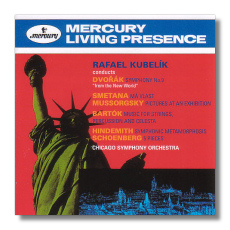
Mercury's bargain Kubelik/CSO set is worthwhile for fans of this conductor. The early 1950's MONO sound is excellent, though there is a little overload occasionally. The Dvorak 9th and Ma Vlast, 2 of Kubelik's staples, are highly characterful and compare well with his stereo remakes. Both Kubelik and the CSO's performances are also more lively in those days than later. A fine issue.

29 May, 2009

Listening Log 30/05/09: Mostly Disappoinments

Listening Log 30/05/09: Mostly Disappointments

Good:
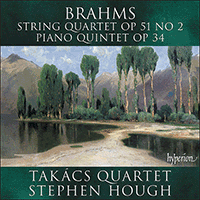
I have long been a fan of the original Takacs Quartet (on Hungaroton). Today it is international rather than Hungarian (on Hyperion) and it shows in the playing. While Edward Dusinberre is refined and the overall playing is still dynamic and spirited, the ensemble lacks weight and is less tonally blended than before. Brahm's String Quartet No. 2 comes off better here. Although a little studied, it is fastidiously detailed, with moments of springing rhythm, almost enough to offset the smaller scale (I prefer bigger-boned Brahms). The piano quintet is a more curious affair. It is a widely dynamic reading that scrutinizes the dynamic markings. It is not a bad reading, but it lacks true passion (like the Budapest/Serkin on Columbia/Sony). As before, I am not enamored of Stephen Hough's Brahms playing, rather clanging in sound and lacking in tonal heft.

Boulez and VPO in Bruckner's Symphony No. 8 is certainly a curious affair. This recording has been widely hailed. I do like many details here and there, but overall I just don't receive the grandeur inherent in the Brucknerian ebb and flow. Most unfortunately, the sublime adagio is rather devoid of sentiment. I listened to the Japanese DG and sound is not great.

Fair:
Judged by this compilation of Bach's own transcriptions and reconstructions, I don't understand why Akademie fur Alte Musik has made a reputation for themselves. The playing is excellent but rather metronomic. In these familiar works (albeit in other guises) this just doesn't work.

Even more curious is Mahler Symphony No. 5 as played by the San Francisco Symphony under Michael Tilson Thomas (from live sessions). The SACD sound is excellent but I have to agree with some Amazon readers that the playing of the SFSO, although detailed and accurate, is not in the top echelon, nor for those used to more idomatic Mahler playing (like the Concertgebouw, even NYPO and CSO). MTT's conducting is rather free-wheeling, and there are passages that sound spontaneous and interesting. However, this is certainly not a coherent reading and much of Mahler's grandeur and nightmares are missing in equal measures. This is the first MTT Mahler I have listened to.

28 May, 2009

Listening Log 29/05/09: Symphonic Heavyweights

Listening Log 29/05/09: Symphonic Heavyweights

In the last forty days I had been going back and forth between HK, Taipei and Fuzhou (mother's birthplace). Yesterday was my first real free day. From the Tsuen Wan library I obtained a stack of expensive (SA)CDs and settled down for some serious listening.

Excellent:
Dutch PENTATONE, in association with Dutch POLYHYMNIA, has been issuing a hugh number of SACDs, many in multi-channel. All their own DSD recordings that I have heard have excellent sound, though one may debate on their artistic merits. But they do have a stable of excellent musicians, like Julia Fischer, to cite just one. Pentatone has also been re-issuing older analogue PHILIPS recordings that have originally recorded third (and more) channels, but I'd skip those.

Slowly but surely, Pentatone is half-way through the Shostakovich cycle, all featuring the redoubtable Russian National Orchestra conducted by different conductors. From the two releases that I have heard, they are top-choice material, from both musical and sonic standpoints. I suspect the RNO is incapable of delivering boring Shostakovich.

Interestingly, although produced and recorded by the same team, in the same Moscow venue, the Jurowski recording has notably better sound. Fortunately for us, the interpretation is excellent. This is the first Jurowski recording that I have heard and I am really impressed. Music Web International has an excellent review that makes a great read. If the Shostakovich Symphony No. 6 does not eclipse memory of the magisterial live account delivered by HKPO/Elder recently, it does dig deep and have exemplary patience and control. I am even more impressed by the Symphony No.1, here given real gravitas by Jurowski that to me sheds new light on this early work. Jurowski's explored everything yet knit everything tightly together, remarkable for a young conductor! The RNO have this music in their blood and play magnificently. Recording is demonstration grade. I'd love to hear a multi-channel demo.

Symphony Nos 5 and 9 are conducted by Yakov Kreizberg and have received much critical praise. Perhaps because I am just a little jaded by the over-abundance of Shosty 5 (live performance and recordings) around I am less enthusiastic. This does not mean the interpretation is not good. On the contrary, it is excellent. Just to give one telling example: although the inner movements have about the same timing as Haitink/Decca, they feel more deliberate. This is because they are highly sculpted, with rhytmic emphasis that serve to impart feelings of gawkiness and, hence, protest under the jubilant surface. If you don't have a recording of the fifth, this is as good a place to start as any. The coupled No.9 (a difficult one to render right) receives yet another superbly structured reading imbued with gravitas, although the first movement does not have quite the effervescence (rightly or wrongly) of Inbal/Denon (also on Burmester CD2!).

Onto Mahler Symphony No. 1, not THAT hard to bring off but not that easy to achieve true distinction. Here are 2 live recordings. The Concertgebouw under Mariss Jansons (RCO; from the booklet, patched from 2 separate occasions) play perfectly (how can they not?) and Jansons has great structural integrity and precise articulation. Sonics too is excellent (also done by Polyhymnia), yet with all that to its credit, the recording misses just a little the all-encompassing quality that Mahler speaks of. "...the symphony must be like the world...it must contain everything...". Judged by Mahler's own words, which is as it should be, EdW's Mahler world mostly comprise only notes, sometimes with no apparent link nor direction; Jansons world has all the notes, much of it purposeful. But in Tennstedt's world (as in Kletzi/EMI) one feels a sense of journey. I prefer the Concertgebouw's playing to the Chicago, but under Tennstedt in this live recording one can feel the tremor in the heart, the calling out, the world. This live recording is only available on Japanese EMI TOCE-13107. Grab it ASAP. The sound is not as resplendent as the RCO release, but still very good. Warning: not for those who dislike slow tempi.

Good:
Much as I love Barbirolli, BBC Legends is scrapping its barrel in the issue of Beethoven Symphony No. 5 and Shostakovich Symphony No. 5, both with the Halle. The Beethoven is good but not as distinctive as his EMI Eroica. The Shostakovich is a Barbirolli curiosity, well played but not competitive today.

06 May, 2009

Listening Log 07/05/09: Essential Bach and Worthless Beethoven

Listening Log 07/05/09: Essential Bach and Worthless Beethoven

Time flies. I have been so busy with family matters that I was a little shocked to find that my last log was published almost a month ago. Here are a few CDs I bought or heard in Taiwan. I can only play them on my cousin's computer.

Excellent:
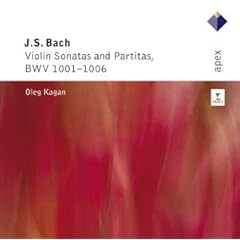
Bach's solo violin works are of course essential library material. After listening to recordings of the greatest violinists, like Milstein and Heifetz, sometimes it's not easy to find newcomers that one likes. This Oleg Kagan Erato recording, long out-of-print, is now re-issued by Warner Apex, 2 CDs for the price of one. Surely a collector's item, so grab it ASAP. This is from a 1989 live concert at the Concertgebouw, and the playing is magnificent, full of humanity. It witholds comparison with any, marred only by an over-reverberant acoustic, but afficionado's would not mind.

Even more than the solo violin works, I love the violin concerti and avidly collect different versions. This DG recording by Francescatti I already have, but when I saw the Japanese pressing (JS Bach 名盤 1200) I just had to buy one. His tone in this 1971 recording is warmer than on some Sony/Columbia recordings. Both the soloist and orchestra play and breathe together in long lines. Despite "period practice", the style here, in long singing lines, cannot be faulted. Let me add here that I have always admired the Lucerne Festival Orchestra under Rudolf Baumgartner. They have made many great discs together and their set of the Brandenberg Concertos and Orchestral Suites on Eurodisc/RCA is still top choice, and no-brainer at budget price. Don't forget, this festival orchestra, though ad hoc, has many famous soloists on its roster and had played under Furtwangler!!

While browsing at Tachung Records in Taipei, which has an excellent audio system, I was tansfixed by this hot Nonesuch (Warner) release of the Beethoven piano concertos. I actually stayed for more than 1 hr listening to the remarkable partnership. Richard Goode's pianism is spontaneous, with great tonal allure, and impeccable in its classicism. With pianism of this order, it's easy to slight the orchestral contribution which, in these of all concerti, are just as vital. I have always loved the sound of this Budapest Festival Orchestra under Ivan Fischer. One admires the beautifully phrased lines and the singing quality. The recording quality is excellent. While here, I should also mention that I recently heard the Pletnev cycle with the Russian National Orchestra on DG (mid-price). Pletnev's playing is cooler and more yang than Goode, but just as immaculate and fastidiously weighted. Highly recommended. I'd get both cyles.


Very good:
I was surprised to see this Janos Starker Cello Sonata cycle, originally issued on Erato and long oop. Now re-issued by Warner Apex, it's eminently worthwhile. The readings are "objective" and straightforward (as always with this cellist). The piano is balanced to the fore but Rudolf Buchbinder's somewhat dry style, with little pedaling, helps the integration much. The recording quality is excellent. Starker admirers need not hesitate.

Why is Beethoven worthless? Because all these Beethoven issues are being sold at bargain price. None of the new Beethoven piano concerto cycles are full price. I haven't heard the newest Pollini and the Kissin cycles.

08 April, 2009

Listening Log 08/04/09: Fiddlers mostly

Listening Log 08/04/09: Mostly Fiddlers (but pianists take the palm)

Excellent:
Alexis Weissenberg's rather objective style turns off a lot of people but always had structural integrity. In the case of Chopin's minor piano works with orchestra, his playing enhanced the works. The French Orchestra play well under Skrowazewski (EMI LP).

The redoubtable Radu Lupu plays a well-nigh perfect Beethoven 3rd, and the Bucharest SO under Conta provide first-rate accompaniment. More impestuous and to be preferred to his Decca remake. Unfortunately it's oop (Quitessence LP).

I am not sure I should put Alexander Paley's performance of the Goldberg Variations here. This is not for the faint of heart. The performance is on 2 CDs and lasts almost 2 hrs. The reason is he takes ALL repeats and adds ornamentations. Not only that, you have to put up with occasional funereal processions too. I like some of it and find others rather strange but it is without doubt different and the Russian pianist (depsite his name) has what it takes! The playing is stylish and his touch is beautiful. I shall be returning to this. Who knows, maybe I shall put it under "intolerable" next time? But returning I am sure. The record label BLUTHNER (paino maker) is new to me.

Very Good:
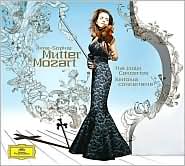
Mutter surprised me in her DG integral Mozart Concertos. Relatively free of mannerism and just a little concession to period practice, the playing is miraculously detailed and tonally tightly focused yet imbued with some sense of spontaneity and surprising rhythmic elan. The LPO, although just a backdrop in the absence of a conductor, play lively enough. Although missing the last degree of give-and-take apparent in the other DG Carmignola/Abbado set, this set is nonetheless one of the best late efforts of Mutter. She surpises sometimes, like in the very broad and romantic slow movement of the Sinfonia Concertante with Bashmet.

Good:
Aside from occasional mannerism in the last movement, Inbal's recording of Schumann's 4th Symphony with the Frankfurt SO (DENON; his first was on Philips) is tightly argued and in resplendent sound, as is the norm with this team.

Sarah Chang (EMI) is all spontaneity in a lovely recording of Mendelssohn's Violin Concerto, partnered nobly by BPO/Jansons. The coupled live Sibelius though is a little lightweight for me.

Francois-Frederic Guy's Beethoven 4th concerto (NAIVE) started off well but suffered from its smaller scale halfway on. In contrast, the more boldly projected (interpretively and sonically) Piano Quintet is quite satisfying, one of the better versions. The Radio Philharmonic France did well under Philip Jourdan.

Henryk Szeryng and Roberto Michelucci both fiddled beautifully in Vivaldi's Four Seasons (both PHILIPS), in accounts that otherwise sound a little dated in the orchestral contribution.

25 March, 2009

Listening Log 25/03/09: Bach and Beyond

Listening Log 25/03/09: Bach and Beyond

Excellent:
Tatiana Nicolayeva's Moscow recordings that were previously issued on Olympia now fetch a good sum on the second-hand market. Fortunately REGIS has now issued all the Shostakovich and Bach. I listened to this potpouri of Bach's smaller pieces and was once again enthralled by the fully pianistic treatment they get from her. This is old fashioned sonority, powerful to the point of near-brutality at times, but tender when called for. Full bodied recording. You should grab all of her recordings on REGIS.

For those who prefer lighter "Bach", Gabriela Montero on EMI serves up solo Bach, but with improvisation. Although always tasteful and not carried to extremes, her improvisations feel freer than Jacques Loussiers', who otherwise has the advantage of the support of bass and percussion. This should appeal to both open-minded classical and jazz fans. Superbly recorded.

Vivaldi's Mandolin concerti are my favorites after the string ones. No one plays them better than ERATO's (now Warner) I Solisti Veneti under Claudio Scimone. This orchestra is more stylish than I Musici and yields nothing to the famous Italian chamber ensembles of our times (Europa Galante, Il Giardino Armonico, Concerto Italiano etc). The sound of the LP is stunning.

Moving on to Haydn. Alban Berg Quartet's EMI readings of Haydn's Op 76 are sadly oop. Too bad, Haydn reveals the ABQ at their finest and most polished, largely without the idosyncracies that sometimes mar their Mozart and Beethoven. Surprisingly, the Revox-sponsored Swiss Carmina Quartet on DENON in Haydn almost get up to their level in ensembleship. Why are they so little known? This morning I listened to the Carmina's Szymanowski quartets (coupled with a little early Webern). Superbly done and atmospheric. A little-known quartet playing music of a little-known composer, who died in absolute poverty.

The Beethoven 4th and Schumann piano concerti were played with incredible artistry by Wilhelm Kempff (BPO/Leitner and BRSO/Kubelik) on DG. I should have visited the Schumann (not to be confused with his earlier account) sooner. Schumann rarely sounds so free, or improvisatory. This is my favorite now, and it sounds great on LP; but it surprises me that this seems not to be available on single CD. In comparison, Richter's Beethoven 3rd (VSO/Sanderling) on the same label is a little too subdued.

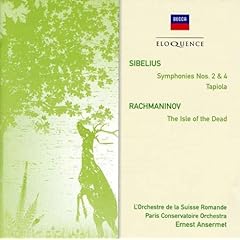
A rare LONDON LP of OSR/Ansermet in Sibelius 4th is hughly satisfying. Ansermet's reading is not the darkest, but it's brooding enough and his structural grasp kept the waves coming and the listener is ultimtaley exhausted and overwhelmed by the grandeur. Another great recording by the great Ansermet. Shattering sonics. It is just now available on Australian Eloquence. You must grab it asap.

Lastly, 2 great RCA LPs showcase the synergy between Szeryng and Rubinstein. The Brahms sonstas are refined and the early Beethoven is energized.

Good:
I have always liked the works of Berthold Goldschmidt, a composer of Entartete Musik (degenerate music). His Cello concerto was played with fire by Yo-Yo Ma (Montreal/Dutoit) and the violin concerto was played beautifully by the dedicatee Chantal Juillet (PO/composer). Many supremely talented composers of those years either languished in obscurity or worked for Hollywood. A loss to music. Superb DECCA CD.

On BIS, Yevgeny Sudbin plays Scriabin with great clarity and beauty, yet with inevitability freuqently missing in Scriabin interpreters (particularly non-Russian ones). Mot much mist here, and some of the music, like the mazurkas, actually sound better that way! Very good recording.

21 March, 2009

Listening Log: 21/03/09

Listening Log
21/03/09


With this article I shall start a new series that logs what I have listened to date, at least for what's worthwhile. In contrast to more comprehensive surveys in my other Blogs (CD Library A and B), each CD/LP entry in this series shall be only briefly treated, mostly with no links provided. Should you be interested, it's easy to search for the CDs with Google.

The CDs mentioned in this session were obtained from the Flushing public library.

Superb:
For me, up to now Hilary Hahn's DG discography has not met the same standards, artistically and sonically, of the SONY releases earlier in her career. My impression has changed with this newest release. Although not an echt-romantic Sibelius (and some may not like this), this is a FRESH and fluent account that benefits from the exceptionally detailed accompaniement of the Swedish Radio SO under Salonen. The coupled Schonberg is arguably even more of a marvel. Hahn's impeccable phrasing made this piece seem not nearly as difficult (took her 2 years to learn) or acerbic as usual. A fine effort in all. Very good sound.

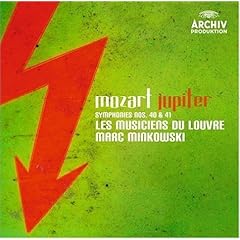
For those not aversive to period performances in Mozart, Minkowski's Mozart Symphonies CD (DG) is refreshing. Les Musiciens du Louvre (Based in Grenoble) play with real bite in the Jupiter, imparting a sense of inevitability that the No. 40 narrowly misses. The Idomeneo ballet filler is crakling. Overall, a great effort, complemented by an excllent recording.

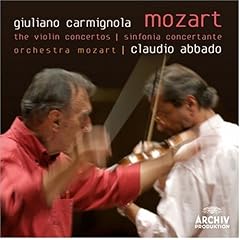
It took me a while to warm up to Giuliano Carmignola's DG 2-CD set of Mozart violin concerti with Orchestra Mozart (one of Abbado's youth orchestras) under Abbado. This is not in the old style of Grumiaux or Szyerng, but Carmignola's playing, besides boasting a sweet and variegated violin tone (that confuses you momentarily that he's playing Vivaldi), illuminates all kinds of details, yet knitting them (unlike Kremer) into an organic whole. Speed is fast, and the orchestra plays with utter committment, digging deep and with little vibrato, in period style. Abbado's conducting is stylish. Although likely not for those who like "sweet" Mozart, these non-sentimenatl accounts reward repeated listening. Excellent recording.

Good:
I have always liked Ernest Bloch's much neglected music. There's a lot more than Schelomo! His chamber music, notably the quartets, are particulalrly fine. On Hyperion, the 2 excellent piano quintets are played by Piers Lane and the Australian Goldner String Quartet. They are very well played, though even more bite would have been welcome. As usual, Hyperion's sound, though not bad, is a little veiled (likely too much added reverberance) for me. Note that I am usually NOT a fan of this label. But this is unduly neglected music, and I look foward to hearing more in the Hyperion/Bloch canon.

After the Schwarzkopf/Szell, it's hard to listen to other versions (with the exception of the creamy Gundula Janowitz/Karajan) of Strauss' Four last Songs. The reason for this preference is that these songs, written a year before Strauss' death, really need interpretation and word-pointing. Ricarda Merbeth does better in the softer, rueful, and regretful, moments. Overall she's very good, better than many. The Weimar Staatskapelle play beautifully and Wit conducts cogently. Good recording. Another excellent Naxos release.

With Reservations
Rafal Blechacz, 2005 Chopin Competition Gold medalist and the only Pole after Zimerman, has seen a meteoric rise. I could not get tickets to his Chopin concerto last year with the NYPO. His DG Chopin Preludes show an individual mind at work. He plays with excellent color, but since the overall tempo is a little slow and he pulls things around a little too much for a first listen, a little feeling of homogeniety sets in from time to time. However, some of it is strangely memorable and I should like to return to this CD and see whether things shall grow on me. Afterall, is there a complete Chopin preludes set that is NOT wilful at some point? One thing is for sure, he is a pianist to follow. Recording is fine but not exceptional.

I am a fan of Osmo Vanska, and have heard him to good effect live with the HKPO and the Minnesota Orchestra. However, I have mixed feelings about the first Beethoven CD I have heard, a coupling of Symphony No. 1 and 6. The playing is excellent, with stupendous bassline (just as in concert with the MO). The No. 1 receives a strong performance, but the No. 6 is less distinctive, even less attractive than the live performance with the HKPO. This is a BIS hybrid SACD/CD, which at least on the CD layer has a somewhat veiled sound that does not help.