Concert Review: Takacs String Quartet
September 20, 2016, Hong Kong University, Grand Hall
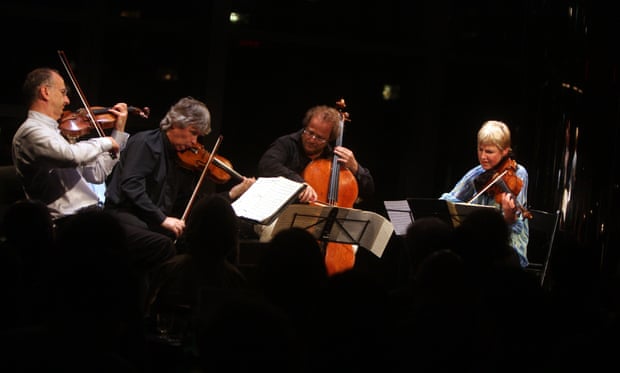
Takacs String Quartet
All Beethoven
I try not to miss a good string quartet. Even in HK, in recent years I got to hear the Borodin (multiple times), Hagen, Alban Berg, Emerson, Zehetmair, Shanghai, to name a few. I even follow younger quartets (in NYC), like the Artemis, Belcea, Parker and Jupiter. Since the early 80's, I have heard quite a few esteemed ensembles, like the Juilliard with Robert Mann as leader, and the incredible Talich and Stamic. However, there are just too many of them to catch up with, and somehow I have missed the Takacs, surely one of the world's most prestigious string quartets, until now.
I have however heard many of their CD's. I owe many of their older Hungaroton recordings, which with time are now displaced by their later, and more widely distributed Decca and Hyperion equivalents. As an example, I have both the 1985 Hungaroton (reviewed here by NYT) and the widely acclaimed 1998 Decca Bartok cycles, and they are very different, yet the equally superb Hungaroton is almost forgotten these days. Our public library has most of their recent Hyperion recordings, and I have heard all of them.
The now Colorado based quartet has two original members, second violinist Karoly Shranz and cellist Andras Fejer. Juilliard trained Englishman Edward Dusinberre has been the first violinist since 1993, and the current violist is American Geraldine Walther.
The quartet is over forty years old and has had quite a few personnel changes - that's enough turmoil to cause even great ensembles to disintegrate or deteriorate. Yet the Takacs have managed to stay on top of the game, quite a feat!
Edward Dusinberre has just written a book Beethoven for a Later Age: The Journey of a String Quartet, which has been well received. Some reviews (Telegraph, Independent) allow us peripheral glimpses into the inner workings of the quartet. The author himself introduces his book and in The Guardian touches on his life with the Takacs. A revealing passage in this article described Dusinberre's doubts when recently performing the Op. 132: "...Struggling on stage to maintain my energy, I could not judge if we were
communicating an appropriate sense of repose or merely sounded
lethargic. Typically, Beethoven’s musical phrases tell a rapidly
evolving story, requiring a sense of direction and clear shaping, but
here the pace of events is extraordinarily slow.."
I suspect during some parts of the performance Dusinberre would have entertained the same doubts again, as we did too. The first few numbers of the Op. 131, which concluded the concert, felt rather piecemeal and devoid of vitality. Fortunately, the quartet seemed energized by the Presto, and played expressively in the Adagio and Allegro that ensued. Overall, Beethoven's elusive and mercurial shifts in his late works were not caught; and a certain spiritual sense, be it struggle or longing, were not in view. A certain pallidness also pervaded the opener, Op. 18/2, sounding over-studied, hence lacking in classical repose and fluidity, the latter in my opinion the most important element in the early quartets.
Make no mistake, the Takacs are a supremely accomplished ensemble. No matter the composer, the current incarnation on records never stray far from a proper style, and that is no easy thing and must have taken a lot of work. At their best, their playing was at ease, their sonority blended and full-bodied, as evidenced by the accomplished performance of the Op. 95. In terms of sonority, this performance mirrors closely what I have heard on Hyperion.
Chemistry is an interesting and elusive thing. One of the greatest and most cathartic chamber music experience of mine was first hearing the Borodin Quartet in Macau with only one of its founding member, the immortal Valentin Berlinsky. That evening, Borodin's Second String Quartet, not a usual favorite (nor mine), was played and I was astonished that suddenly tears streamed down my cheeks. In the ensuing years, after Berlinsky passed away, I heard the quartet a couple more times. Despite the fact that the first violinist, Ruben Aharonian, is a superb violinist (who I think can walk the line and live more dangerously than Dusinberre, though I'd hate to compare them this way) and had achieved rapport with Berlinsky in the lineup, subsequent performances just suffered in comparison. One sighs. Things change and can never be the same.
That was my first time in the Grand Hall of Hong Kong University. It is similar in construction (plan and material) to the various good-sounding City Halls. The sound was good, though my friends complained the cello was not loud enough. I rather think the dynamics was a little subdued. Somehow I suspect that played a role in what I heard. An enigma.
I have been a classical music fan for over 40 years, pre-dating my obsession with hifi by more than 10 years. Music lingers in the mind almost more than any other sensual pleasure. It's a corner you can call your own. Other non-music art events that I find enjoyable shall also receive some treatment in this page.
25 September, 2016
06 July, 2016
Concert Review: HKPO - Bezhod Abduraimov - Ashkenazy
July 1, 2016, CCCH
HKPO - Bezhod Abduraimov - Vladimir Ashkenazy
Prokofiev - Elgar
I was really looking forward to the return of both soloist and conductor, and I was not disappointed.
Behzod Abduraimov played a most enticing Rachmaninov 3rd last year, but this year's Prokofiev 3rd Piano Concerto was even more heaven storming. From start to finish, basically he tore up the piano. I have never heard anyone bang louder in the middle registers. In comparison, the bass was less clear and the treble somewhat monochromatic and percussive, though this is par for the course for Prokofiev. In comparison, Wang Yuja in 2010 (here) and 2012 (here) got more nuance out of this concerto. The orchestra under the Russian born Ashkenazy naturally got the full measure of this concerto, playing with power, precision, even some wit and sardonic edge when called for. In all, a fine effort. Although the piano had deteriorated sound by then, the Gluck-Sgambatti Melodie made a perfect encore.
Askenazy is a relatively late comer to Elgar, but his understanding is formidable. He has recorded much of Elgar for Exton and other labels, to almost universal acclaim. As he has delivered outstanding performances of the composer's In the South and Cello Concerto in HK in 2014 (here), I was really looking forward to his Elgar 1st Symphony, and I was not disappointed.
The only reservation I had was the mammoth first movement, which Ashkenazy did not manage to completely hold together. The tempo was somewhat slow and from the middle on sometimes the quieter passages seemed rather episodic, not helped by HKPO's somewhat mechanical sounding strings. However, from the second movement on, the symphony went from strength to strength, with a positively thrilling finale. Ashkenazy's taut conducting and perfect balance had one's attention riveted. The brass played valiantly, even more heroic than in Bruckner. The winds' comparative weakness showed, but mattered little in this symphony.
I stood up and yelled "bravo" twice; had not felt like that in quite a while!
July 1, 2016, CCCH
HKPO - Bezhod Abduraimov - Vladimir Ashkenazy
Prokofiev - Elgar
I was really looking forward to the return of both soloist and conductor, and I was not disappointed.
Behzod Abduraimov played a most enticing Rachmaninov 3rd last year, but this year's Prokofiev 3rd Piano Concerto was even more heaven storming. From start to finish, basically he tore up the piano. I have never heard anyone bang louder in the middle registers. In comparison, the bass was less clear and the treble somewhat monochromatic and percussive, though this is par for the course for Prokofiev. In comparison, Wang Yuja in 2010 (here) and 2012 (here) got more nuance out of this concerto. The orchestra under the Russian born Ashkenazy naturally got the full measure of this concerto, playing with power, precision, even some wit and sardonic edge when called for. In all, a fine effort. Although the piano had deteriorated sound by then, the Gluck-Sgambatti Melodie made a perfect encore.
Askenazy is a relatively late comer to Elgar, but his understanding is formidable. He has recorded much of Elgar for Exton and other labels, to almost universal acclaim. As he has delivered outstanding performances of the composer's In the South and Cello Concerto in HK in 2014 (here), I was really looking forward to his Elgar 1st Symphony, and I was not disappointed.
The only reservation I had was the mammoth first movement, which Ashkenazy did not manage to completely hold together. The tempo was somewhat slow and from the middle on sometimes the quieter passages seemed rather episodic, not helped by HKPO's somewhat mechanical sounding strings. However, from the second movement on, the symphony went from strength to strength, with a positively thrilling finale. Ashkenazy's taut conducting and perfect balance had one's attention riveted. The brass played valiantly, even more heroic than in Bruckner. The winds' comparative weakness showed, but mattered little in this symphony.
I stood up and yelled "bravo" twice; had not felt like that in quite a while!
20 June, 2016
Concert Review: HKPO - Jaap - Karen Gomyo
June 18, 2016, CCCH
HKPO - Jaap van Zweden - Karen Gomyo
Rossini - Bruch - Borstlap - Respighi
A spirited reading of Rossini's La Gazza Ladra Overture opened the program. The main attraction, Bruch's Violin Concerto No. 1 received a tidy performance from the team. Karen Gomyo has a nice tone and played smoothly, but the feeling was somewhat small-scaled. Jaap delivered an excellent accompaniment (as he always does), but wanting was the piece's sense of brooding and melancholia.
Second-half opened with a surprisingly tonal (in the twentieth century sense) newly commissioned work by Borstlap, Solemn Night Music. The program extravagantly introduces the composer as "...one of the first composers in Europe to explore the possibilities of a revival of the classical tradition...", and the music "...which absorbs the musical style of the 20th century, presents related ideas which are constantly varied and almost never repeated literally, so that we hear the same things in ever newer forms...". Unfortunately, while we hear snippets here and there reminiscent of Schoenberg's Verklarte Nacht, these were indeed "varied" to go nowhere. Borstlap's tepid "night music" is devoid of fantasy and not a patch on Schoenberg's masterpiece. One of the most boring piece of new music I have heard.
Respighi's Pines of Rome suits Jaap to a "T", who brought out every nuance in the luxurious score, and the orchestra was responsive to his every whim, though the piece remained music without much spiritual element. I wished the organ was louder.
17 June, 2016
Concert Review: HKPO Bruckner 4th
June 11, 2016, CCCH
HKPO - Jaap van Zweden - Louis Lortie
Mozart - Bruckner
Concert opened with Mozart's Piano Concerto No. 22, which the sometimes wayward Lortie (in recordings) played surprisingly in a straight and fluid fashion. Although stylish, the last ounce of tonal and rhythmic refinement was missing, and his tone was not the biggest. The orchestral accompaniment was stylish and tight - commendable.
Bruckner's Fourth Symphony (Haas) received an excellent performance. All sections played at an elevated standard. Even more than the strings, the woodwinds seemed more fortified than usual. The brass was largely excellent, with steady and atmospheric horns. More importantly, Jaap van Zweden, an acknowledged Bruckner conductor, mostly had the right feeling of ebb and flow so important to Bruckner. He was also able to coax a full and truly thrilling sound in the climaxes, yet keep things tight and eventful in the equally important softer moments.
However, his approach did not fully carry the last movement. Maybe this sounds like heresy: like the Brahms Fourth, personally I have always found the ending problematic (the alternate editions too), as the ending "blaze" is to me not as thrilling as the first climaxes. Also, there are many start and stop passages, which under Jaap's literal rendition had a feeling remarkably close to the first movement of the Fifth Symphony (this is not as it should be, as the 5th inhabits a completely different world, with a less radiant, more mysterious atmosphere). Thus, in the last movement grandeur was only intermittently evident; my own feeling is you need some more shaping and stretching to achieve true atmosphere, and HKPO had achieved this before in this symphony (under Yuri Simonov and Gunther Herbig; see my write-up here). Lu Jia had also achieved more atmosphere in this symphony with his Macau Orchestra (here).
The HKPO strings are part of the problem. They played with accuracy and power, but not much radiance so important in Bruckner (which Lu Jia/Macau did well). Places like the repetitive figures in the last movement, and the Trio, just felt mechanical and earthbound. But overall, I am satisfied.
vs Philadelphia Orchestra/Yannick Nezet-Sequin's Bruckner 4th
Take all this with a grain of salt, as I did not attend the performance, having only heard it through the radio. It is pathetic that these are the only two performances of Bruckner in HK this year, that it had to be the same symphony and that they came within a month of each other!
I thought the Philadelphia rendition clearly rendered and very well played (as usual for this orchestra), but it had almost the same problem as the same team's Bruckner 9th I heard in Carnegie Hall (here), namely a lack of spiritual dimension in the last movement (Jaap did not escape from this either). In terms of flow, overall I prefer Jaap's conception.
Opinions among my friends were quite divided. Some reveled in the Piladelphia's sonority, while others found a curious lack of spiritual journey. At the HKPO concert, I ran into a dozen acquaintances - they were divided too but surprisingly the majority preferred the HKPO/Jaap performance. There is some brand loyalty and US-bashing here I think, but that is par for the course.
A thought: In the quest for precision, many performances under younger conductors to a variable degree miss the spiritual side of things. This is across the board, a world-wide phenomenon.
Concert Review: Richard Galliano
June 10, 2016, CH
Richard Galliano - City Chamber Orchestra - Jean Thorel
Vivaldi - Villa-Lobos - Piazolla - Galliano
I came to know polyglot musician Richard Galliano through his magnificent Bach album, which I first borrowed from the library. I liked it so much that I bought the CD.
The first half comprised an arrangement of Vivaldi's Four Seasons, for bandoneon, two violins, viola, cello and bass (same as in the Bach album). Although Bach himself had arranged much of Vivaldi successfully, Galliano's working of Vivaldi, unlike his Bach, was only intermittently successful. The bandoneon frequently gets tripped in both fast and slow passages. The string players of the CCOHK are marvelous. In particular, the playing of Concertmaster Amelia Chan was magnificent, completely fluid, and she frequently stole the limelight from Galliano!
Second-half opened without soloist, in a tidy rendition of Villa Lobos Bachianas Brasilerias No. 9, but I personally would like a larger orchestra (or a smaller space) for this composer's mostly sec works.
Piazolla's Aconcagua Concerto found Galliano in his true elements. Simply magnificent, and imho as good as the master's own! If only the strait-laced percussion (drum and tympani) had more Latin flavor!
Then came Galliano's La Valse a Margaux, a beautiful old-styled waltz played to perfection.
The encores were magnificent. The first was a potpurri - I think Galliano's own, maybe partly improvised. I heard everything, a trace of Bach here, maybe Widor too? And then Piazolla and so forth. Great stuff! Then came Piazolla's smoky Oblivion (with orchestral accompaniment) that rounded out a very nice evening.
June 10, 2016, CH
Richard Galliano - City Chamber Orchestra - Jean Thorel
Vivaldi - Villa-Lobos - Piazolla - Galliano
I came to know polyglot musician Richard Galliano through his magnificent Bach album, which I first borrowed from the library. I liked it so much that I bought the CD.
The first half comprised an arrangement of Vivaldi's Four Seasons, for bandoneon, two violins, viola, cello and bass (same as in the Bach album). Although Bach himself had arranged much of Vivaldi successfully, Galliano's working of Vivaldi, unlike his Bach, was only intermittently successful. The bandoneon frequently gets tripped in both fast and slow passages. The string players of the CCOHK are marvelous. In particular, the playing of Concertmaster Amelia Chan was magnificent, completely fluid, and she frequently stole the limelight from Galliano!
Second-half opened without soloist, in a tidy rendition of Villa Lobos Bachianas Brasilerias No. 9, but I personally would like a larger orchestra (or a smaller space) for this composer's mostly sec works.
Piazolla's Aconcagua Concerto found Galliano in his true elements. Simply magnificent, and imho as good as the master's own! If only the strait-laced percussion (drum and tympani) had more Latin flavor!
Then came Galliano's La Valse a Margaux, a beautiful old-styled waltz played to perfection.
The encores were magnificent. The first was a potpurri - I think Galliano's own, maybe partly improvised. I heard everything, a trace of Bach here, maybe Widor too? And then Piazolla and so forth. Great stuff! Then came Piazolla's smoky Oblivion (with orchestral accompaniment) that rounded out a very nice evening.
28 May, 2016
Concert Review: HKPO - Atherton - Koranyi
Concert Review: HKPO - Atherton - KoranyiMay 28, 2016, CCCH
HKPO -Atherton - Jakob Koranyi
All Russian program
The HKPO was in fine form. David Atherton conducted in his familiar style: literal, driven and not much subtlety, but the familiar music carried the day. Borodin's Polovtsian Dances was a tidy opener.
Swedish cellist Jakob Koranyi substituted for Jing Zhao at short notice. He had a good tone but the sound was just too small for Shostakovich's Cello Concerto No. 1, getting covered by the orchestra. One has to fill in the blanks. Principal horn Lin Jiang was flawless.
The orchestra clearly loved Rimsky Korsakov's Sheherazade and the many soloists gave their best. Concertmaster Wang Jing as usual played with commitment, although the portrait was definitely on the yang side. One wished for a little more tenderness in many episodes (only in the andantino did Atherton cared to show a little) and a little more characterization in transitions would not be remiss (though one would not expect this of this conductor).
Overall, a satisfying concert.
25 May, 2016
Patti Smith M Train
pic from NYT.Talk Book: Patti Smith M Train
"...without a doubt we sometimes eclipse our own dreams with reality..."
After reading Just Kids, I lost no time in reserving Patti Smith's newest book, M Train, from the HK Public Library. A month and a half later I got it, and since I I knew I cannot renew (others are in the line) I devoured it in just a few days, perhaps not the best way to read this mysterious beast of a creation, but likely just as well as I'd never fully comprehend her dreamscapes and lofty travails anyway.
For her journeys to obscure places, often to honor heroes of the past (concisely summarized by the NY Times review) are awesome; we mere mortals would never entertain such ideas. However, comprehension or not, one has to admire her determined nature.
As words and scenes leap out from every sentence, her colossal spiritual dimension is revealed. In an age when most people spend more time on researching what to do, wear or eat than actually doing things, I can only applaud someone who wouldn't care about fashion, fine dining and most luxuries (surely Patti Smith couldn't care less about hifi, even if she's a musician). In an age when people spend more time rating things, choosing emoticons and giving thumb-ups, in general living the life of others rather than discovering themselves, Patti Smith examines every recess of her psyche, excavates every buried emotion, and crafts a lifetime of words to describe her dreams, premonitions, pain. Indeed pain and loss, her own as well as reflections through others, permeate the book.
Patti Smith knows herself as well as any writer I have read, and the above quote perfectly describes this book.
17 May, 2016
Concert Review: Sinfonietta-Frang-Halls

Concert Review: Sinfonietta-Frang-HallsMay 14, CH
HK Sinfonietta - Vilde Frang - Matthew Halls
Haydn and Britten
Each half opened with Haydn and ended with Britten. Matthew Halls is an early music specialist but it was Britten who fared the better.
Haydn's Overture L'Isola Disabitata was tidy. But the Symphony No. 96, "Miracle", was too cautious. Perhaps the Sinfonietta was not quite attuned to quasi-period style playing. In any case, the inner movements (the wind playing was good) fared better than the outer ones, which came across as a little square. I also think the Sinfonietta is in my experience (more often than not) not so effective in reduced configuration.
Britten's Violin Concerto received a faultless rendition by Vilde Frang. She has a natural, breathing style and sweet tone across the spectrum. A minor quibble is that her sound is slightly on the small side, given that I was seated only in the middle of the hall (I also heard her in Carnegie Hall, which was too big for her I thought). The orchestral part was tidy and well controlled though the ultimate chemistry between soloist and orchestra was missing. Most unexpected was an absolutely superbly characterized Four Sea Interludes - each tableau was wonderfully detailed and harmonically full, the entire effect thrilling. Even played by famous orchestras, this piece can often be a bore in concert, but this account is a happy exception.
17 April, 2016
Haitink Mahler 9 Alsop Mahler 5
pic of Haitink from NYT
Concert Review: Mahler 9 and 5
April 14, David Geffen Hall
Bernard Haitink - New York Philharmonic
Mahler 9
A frail Haitink returned to conduct the NYPO in Mahler 9. This last completed Mahler symphony has always been one of his calling cards. I love his first recording, which received universal praise, and still have vivid memory of his unsurpassed 9th with the Berlin Philharmonic at Carnegie a good three decades ago.
As with his performance with the same forces of Mahler 3 two years ago, Haitink directed the orchestra with minimal motions and absolutely no fuss, yet a sparingly used and modest tightening and shaking of the fist could elicit a thunderous response from the orchestra in true climaxes. Haitink mostly just let the orchestra play, and they did so with great character. Haitink rarely highlights, yet I have never heard more details in the score.
Although sometimes one may have wished for a little more sardonic edge, the music could not have unfolded more organically. An important element in this type of artless approach is the contribution of the players. The brass and winds were particularly irreproachable, characterful in solo's and lucid even in the densest passages.
Haitink has aged even more since two years ago. Even the little steps up and down the podium proved laborious. I hope I shall get to hear him again.
April 16, Carnegie Hall
Marin Alsop - Baltimore Symphony Orchestra
Puts The City - Mahler 5
A new work by prize-winning composer Kevin Puts opened the program. The City was commissioned to commemorate the 100th anniversary of the Baltimore SO and 125th year of the Carnegie Hall. Alsop made a little speech. The work was three years in the making and the programmatic work unexpectedly "had to consider" the recent riots and aftermath of the Freddie Gray shooting. The music was predictable enough in a post-minimalist way. It was accompanied by a film by Robert Bartolomeo, an unending succession of shots of Baltimore Streets and old photos. I found all of this pedestrian, even tacky. To me, the work was an uninspiring transposition of Philip Glass' Koyaanisqatsi, not one of his best works and accompanied at its premiere by a boring film too.
In comparison to the NYPO of two days ago, the limitation of the Baltimore Symphony showed rather embarrassingly. Marin Alsop's all-baton manner, though fluid and non-histrionic, also contrasted with Haitink's economy. In Mahler 5, the orchestra had a good, integrated sound, but there were obvious weaknesses. The winds in particular did not project well the Mahlerian swagger. Lower strings were also a little too light to provide a foundation. The upper strings played very precisely and were well molded by Alsop, but they too lacked power in key moments. Overall, there was a lack of transparency in the playing. Alsop's interpretation was fine and straightforward, but the execution, though tidy, was not of the highest caliber.
NYT review
Concert Review: Mahler 9 and 5
April 14, David Geffen Hall
Bernard Haitink - New York Philharmonic
Mahler 9
A frail Haitink returned to conduct the NYPO in Mahler 9. This last completed Mahler symphony has always been one of his calling cards. I love his first recording, which received universal praise, and still have vivid memory of his unsurpassed 9th with the Berlin Philharmonic at Carnegie a good three decades ago.
As with his performance with the same forces of Mahler 3 two years ago, Haitink directed the orchestra with minimal motions and absolutely no fuss, yet a sparingly used and modest tightening and shaking of the fist could elicit a thunderous response from the orchestra in true climaxes. Haitink mostly just let the orchestra play, and they did so with great character. Haitink rarely highlights, yet I have never heard more details in the score.
Although sometimes one may have wished for a little more sardonic edge, the music could not have unfolded more organically. An important element in this type of artless approach is the contribution of the players. The brass and winds were particularly irreproachable, characterful in solo's and lucid even in the densest passages.
Haitink has aged even more since two years ago. Even the little steps up and down the podium proved laborious. I hope I shall get to hear him again.
April 16, Carnegie Hall
Marin Alsop - Baltimore Symphony Orchestra
Puts The City - Mahler 5
A new work by prize-winning composer Kevin Puts opened the program. The City was commissioned to commemorate the 100th anniversary of the Baltimore SO and 125th year of the Carnegie Hall. Alsop made a little speech. The work was three years in the making and the programmatic work unexpectedly "had to consider" the recent riots and aftermath of the Freddie Gray shooting. The music was predictable enough in a post-minimalist way. It was accompanied by a film by Robert Bartolomeo, an unending succession of shots of Baltimore Streets and old photos. I found all of this pedestrian, even tacky. To me, the work was an uninspiring transposition of Philip Glass' Koyaanisqatsi, not one of his best works and accompanied at its premiere by a boring film too.
In comparison to the NYPO of two days ago, the limitation of the Baltimore Symphony showed rather embarrassingly. Marin Alsop's all-baton manner, though fluid and non-histrionic, also contrasted with Haitink's economy. In Mahler 5, the orchestra had a good, integrated sound, but there were obvious weaknesses. The winds in particular did not project well the Mahlerian swagger. Lower strings were also a little too light to provide a foundation. The upper strings played very precisely and were well molded by Alsop, but they too lacked power in key moments. Overall, there was a lack of transparency in the playing. Alsop's interpretation was fine and straightforward, but the execution, though tidy, was not of the highest caliber.
NYT review
Subscribe to:
Posts (Atom)