Concert Review: The MET Orchestra and Boulez
May 16, 2010, Carnegie Hall
The MET Orchestra-Pierre Boulez-Deborah Polaski
Bartok-Schoenberg
In the opera house, the MET Orchestra under the long reign of Levine has always been an excellent orchestra. In non-opera repertoire they seem too to have maintained a small foothold and a high standard, though I have not been overly enamored of their recordings. This marked the first time I heard them outside the MET pit.
It was not surprising at all that the orchestra played with fine nuance and great attention to color and mood. One can say the musicians were almost vocal in their outpouring. However, despite the very fine playing I could not be as enthusiastic as the NYT review. Boulez, though frail, conducted just as he always did, with superb concentration over the considerable span of the Bartok Wooden Prince but, as one is unreasonably to expect from him, underplayed the score's more visceral and elemental aspects. I found the same to be true of Deborah Polaski in Schoenberg's Erwartung: she sang well but I felt she had not injected enough passion into the proceedings; lack of hysteria is a reservation in this of all pieces.
But I was glad for an oppoptunity to hear 2 pieces not commonly encountered in the concert hall.
21 May, 2010

14 May, 2010
Concert Review: NYPO-Masur
Concert Review: NYPO-Masur May 12, 2010, Avery Fisher Hall NYPO-Kurt Masur Beethoven-Bruckner
Somehow I had not managed to catch Kurt Masur during his reign at the NYPO. Ever since I heard him live in a complete Beethoven cycle with the miraculous Leipzig Gewandhaus Orchestra at Carnegie Hall in the late 70's I have become one of his fans. The NYPO audience, post-Maazel and entering the Alan Gilbert era, gave him a great welcome even before the first down-beat.

 The concert opened with Beethoven Symphony No.1. Coming right after Orpheus' performance of No. 2, the difference could not have been greater. Masur's superbly virile performance, with only slightly reduced strings, had a sonorous bass line and prominent balance of winds, reminiscent of the so-called "Central European" style. It revealed many more details and a sophisticated rhythmic sense infused the performance. The "Haydnesque" element was clearly heard. It goes without saying too that the brass and woodwinds far outstripped their Orpheus conterparts. This was a performance by a master who had lived with the piece all his life. Indeed Masur had recorded at least 2 complete cycles on Philips, both with his incomparable Leipzig orchestra. The first, scattered now on several pairs of Philips Duo, is IMHO one of the best ever, and even offers superior sonics to the remake. It is now also available conveniently in a multichannel SACD/CD set issued by the reliable Pentatone.
 Of the magnificent Bruckner Symphony No. 7, little need to be said (finally). From the first bar, it completely outclassed a previous performance by the same orchestra conducted by Zubin Mehta. The same sophisticated rhythmic sense also pervaded the breathing performance; subtle rather than forceful, it gave passages, such as the scherzo, a "Schubertian" lilt entirely appropriate for the music. The perfect balance and chording of grand themes could only have come from decades of experience. Diverging a little into HiFi, I shall quote Robert Harley's conclusion on the dCS Puccini/U-Clock: "...simply presents more musical information to the listener without calling attention to the fact that it's presenting more information..." If you read the NYT review, it basically says the same. That is what separates a master from lesser "maestro's". The NYPO played magnificently for Masur. In case you wonder, Masur's also has a solid Bruckner cycle on RCA.
Somehow I had not managed to catch Kurt Masur during his reign at the NYPO. Ever since I heard him live in a complete Beethoven cycle with the miraculous Leipzig Gewandhaus Orchestra at Carnegie Hall in the late 70's I have become one of his fans. The NYPO audience, post-Maazel and entering the Alan Gilbert era, gave him a great welcome even before the first down-beat.

 The concert opened with Beethoven Symphony No.1. Coming right after Orpheus' performance of No. 2, the difference could not have been greater. Masur's superbly virile performance, with only slightly reduced strings, had a sonorous bass line and prominent balance of winds, reminiscent of the so-called "Central European" style. It revealed many more details and a sophisticated rhythmic sense infused the performance. The "Haydnesque" element was clearly heard. It goes without saying too that the brass and woodwinds far outstripped their Orpheus conterparts. This was a performance by a master who had lived with the piece all his life. Indeed Masur had recorded at least 2 complete cycles on Philips, both with his incomparable Leipzig orchestra. The first, scattered now on several pairs of Philips Duo, is IMHO one of the best ever, and even offers superior sonics to the remake. It is now also available conveniently in a multichannel SACD/CD set issued by the reliable Pentatone.
 Of the magnificent Bruckner Symphony No. 7, little need to be said (finally). From the first bar, it completely outclassed a previous performance by the same orchestra conducted by Zubin Mehta. The same sophisticated rhythmic sense also pervaded the breathing performance; subtle rather than forceful, it gave passages, such as the scherzo, a "Schubertian" lilt entirely appropriate for the music. The perfect balance and chording of grand themes could only have come from decades of experience. Diverging a little into HiFi, I shall quote Robert Harley's conclusion on the dCS Puccini/U-Clock: "...simply presents more musical information to the listener without calling attention to the fact that it's presenting more information..." If you read the NYT review, it basically says the same. That is what separates a master from lesser "maestro's". The NYPO played magnificently for Masur. In case you wonder, Masur's also has a solid Bruckner cycle on RCA.
09 May, 2010
Concert Review: Stravinsky-Gergiev II
Concert Review: Stravinsky-Gergiev II
The Russian Stravinsky: A Philharmonic Festival, Avery Fisher Hall
New York Philharmonic-Valery Gergiev, Conductor Chorus of the Mariinsky Theater-Andrei Petrenko, Principal Chorus Master
May 5, 2010 Symphony in C-Capriccio for Piano and Orchestra-Petrushka (1911)
I have increasingly become fond of Petrushka, and it's wonderful to have heard the complete score performed so magnificently. As previously, the orchestra played with high voltage and great flair under Gergiev.
 No more need to be said except that the soloist Dennis Matsuev almost stole the limelight. This is one BIG-toned pianist, infallible, with a great rhythmic sense and swagger. Despite its jazz inflection, Cappricio can sound rather tame on records but this team brought it to life. I first took note of this pianist in his famous "Unknown Rachmaninov" CD, played on the composer's own piano, and available in the HKPL. It's worth searching for.
For more info, read the NYT review. For other concerts in the series, see Part I of my review.
It's too bad I could not get tickets for the last program in this series, as much for the Rite as for a chance to hear another star, pianist Alexei Volodin.
06 May, 2010
Concert Review: Orpheus with Ryu Goto
 Concert Review: Orpheus with Ryu Goto
May 4, 2010
Orpheus Chamber Orchestra Ryu Goto, Violin
Stravinsky-Bruch-Beethoven
I was quite happy to discover this under-publicized concert by the famed conductorless Orpheus Chamber Orchestra, sponsored by Korean Daiwo Bank. The hall was about 80% full, with many Asian faces that greeted Violinist Ryu Goto's entry with screaming passion fit for pop-stars.
Ryu Goto is familiar to HK concertgoers for his stunning rendition of Paganini No. 1 with the HK Sinfonietta, one of the most perfect concerti I have ever heard live (reviewed in this Blog previously). Although I was very eager to hear him in the Bruch Violin Concerto No. 1, I have to admit a certain disappointment created by overly high expectation. While he played beautifully, with an exquisite tone, I had one major reservation not mentioned in the NYT review. Volume. His tone was just a shade small for this large hall; bigger than Cho-Ang Lin's, but just enough, lacking the power of some other (maybe lesser) soloists. The perfect solo Paganini encore fared much better and brought back memory of his previous performance in HK. This points up one thing: Paganini is easier to project than many romantic pieces.
I have not been that impressed by Orpheus on record, and so I was surprised by the big sound Orpheus made in this romantic repertoire. The small string body played wonderfully. One did not much miss the big sweep in the Bruch, and gained insight into the part-writing. Again, the strings shone in the Beethoven Symphony No. 2, but I found the woodwinds and brass to be only good and not up to the standard of the strings. Their solo's were relatively bland and their blend was not sophisticated compared to their counterparts in the better orchestras. It follows that I found the opener, Stravinsky's wind and brass-dominated Octet tidy but without flair, which the music sorely needs.
02 May, 2010
Concert Review: American String Quartet

 Concert Review: American String Quartet
May 1, 2010, Merkin Concert Hall
American String Quartet
Schubert/Webern/Berg
I have been attending more and more chamber music concerts. I am not familiar with the American String Quartet, which enjoy longevity (rare in the world of quartets) and apparently, have a fine reputation. At least 3 members are on the faculty of the Manhattan School of Music. This challenging program centers on the Viennese School.
The foursome surprised me. While notably American in their bold playing, their ensemble was of a very high caliber. Blending of the voices was seamless, attacks in unison and solo's delivered with flair. The tightly controlled Webern's Five Movements was a cornucopia of sound, from explosive outbursts to the merest of whispers. The Berg String Quartet, Op 3 that followed was big and splashy. Leader Peter Winograd, steady and infallible, really dug in, not afraid to let in a trace of coarseness.
The lengthy Schubert's Quratet in G, D887 is a challenge for any ensemble. The performance was technically impeccable and although I admired their sheer stamina, I was somehow unmoved, unlike the works from the Second Viennese School that went before. I attribute this to a lack of rhythmic subtlety. The Schubertian lilt was in short supply. Despite bold playing, there was a curious lack of inevitablity, of the inexorable progression, of the "tragic" that one feels in Schubert's late works. In contrast, the Quarttetsatz that opened the program was more suited to their iron-clad approach. All in all, this is a quartet that I shall hear again.
The concert was held at the renovated Merkin Hall. The hall was famed for its acoustics, but I'm not so sure this is true now. For the opener I sat up front (lower than stage level) and the sound lacked fullness. After I moved to further back in the hall the sound improved significantly.
29 April, 2010
Concert Review: Stravinsky-Gergiev I
 Concert Review: Stravinsky-Gergiev
The Russian Stravinsky: A Philharmonic Festival, Avery Fisher Hall
New York Philharmonic-Valery Gergiev, Conductor Chorus of the Mariinsky Theater-Andrei Petrenko, Principal Chorus Master
This most amazing series spans several weeks, pairing the familiar and the rare Stravinsky in concerts, all conducted by the amazing Gergiev. Even more remarkably, the series emphasizes choral works that are usually shunned by the general audience, sung by the superb Russian chorus. Plus the star soloists, the incredible programing in this case has translated so far to resounding box office successes, rare for Stravinsky.
More than once I wondered why Stravinksy (beyond the Firebird and Rite) is not more popular with audiophiles. The sophisticated percussive writing and the sheer animal nature of some of the more explosive moments easily put the rather monochromatic Carmina Burana (not a favorite piece of mine) in the shade.
The NYPO have been playing splendidly, with more panache (almost "Russian") and involvment than usual (this orchestra can easily seem aloof), no doubt under the spell of Gergiev. Compared to his own orchestra (heard previously in the same hall in Prokofiev) the difference is relatively small. NY is a little more refined and precise but the Russians had more nuance. The brass of the NYPO has always been superb. They were super-human here, sometimes sounding like one instrument, with unmatched precision in attack and always warm sound.
As mentioned, the chorus is remarkable. Each section sang in unison, the blend seamless, and their dynamic precision is breath-taking, just the vehicle for Stravinsky.
April 23, 2010 Les Noces/Symphony of Psalms/Firebird (1910)
I struck gold with this concert, the second program of the series. Due to the volcanic disruption of European flights, the chrous could not arrive in time for the first program, for which Les Noces was originally scheduled. For this concert Les Noces replaced Jeu de Cartes, and I was delighted. Just the sight of the orchestra was worth the ticket of admission: no upper strings, and 4 pianos! For details reald the NYT review.
Les Noces is not an easy work to listen to at home, but it's spectacularly entertaining in the concert hall. The gloriously rich percussion sound rendered the best of our hifi reproduction a joke. This was followed by the austere Symphony of Psalms, given a precise reading. The complete 1910 Firebird was immaculately paced and subtle, though those more attuned to the showy elements in the suites would have been a little lost.
Read the NYT review for full details.
April 28, 2010 Zvezdolikiy/Violin Concerto/Oedipus Rex
The Violin Concerto was given a strong account by Leonidas Kavakos. The orchestra was excellent, but I felt the last degree of give-and-take between the soloist and orchestra was amiss. A little Bach served as an encore, tidy but not particularly involving.
I am at a lost for word for the dramatic Oedipus Rex. Even more than Les Noces, this is a stunner in terms of sonic spectacular. What a cast, though I thought Waltraud Meier was long past her prime. The male chorus sang with zest. Thanks to the super-titles I enjoyed it immensely.
For details read the NYT Review
28 April, 2010
Concert Review: The Flying Dutchman

Concert Review: The Flying Dutchman
April 26, Metropolitan Opera
Wagner: the Flying Dutchamn
The Flying Dutchman has always been a favorite of mine. Although the plot and libretto are rather absurd and a challenge for any production, the music is headstrong and full of romantic ardor. It is also not overly long. :-)
I attended the second performance on the day the NYT review came out, with general praise of the singers but a severe thumbing down of the conductor, Kazushi Ono. As my interest in the opera lies more in the sweeping orchestral score rather than the vocal writing, I attended with some apprehension.
The family circle audience looked quite different from usual, many younger people, blacks and Hispanics that we don't often see in such numbers. Judging by the way they acted, many were in the venue for the first time. When the light dimmed there were a few yells of "Bravo". This, at the start of the performance! Defenders of Ono? I suspect tickets were distributed through "alternative" channels, at least for this performance.
The first few minutes of the overture was indeed quite rough, the solo's unfeeling, and I prepared for the worst. Slowly, the orchestra warmed up and throughout the evening played with beauty and sureness. Although lacking in the utmost grandeur and atmosphere, Ono paced the opera well and my attention never sagged. Except for the opening bit, I didn't detect the problems noted in the NYT review.
I'd not dwell on the vocals too much. Deborah Voigt was powerful, but I found her German ennuciation too studied and her high notes rather metallic to be completely satisfactory. I was pleasantly surprised by the lyrical singing of Stephen Gould, which he held steady to the end. As the Dutchman, Uusitalo certainly did not match up to Jose Van Dam (who does these days), whom I heard in the awful Jean-Pierre Ponnelle production decades ago. I must say this production is a lot better than that pretentious one.
27 April, 2010
Concert Review: Belcea Quartet
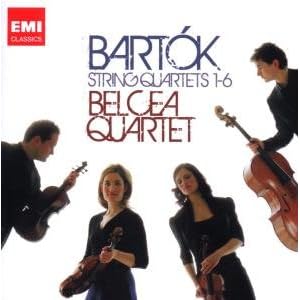 Concert Review: Belcea Quartet
April 24, 2010, Washington Irving High School
Belcea Quartet
Beethoven/Szymanowski/Bartok
The marvelous Belcea Quartet were playing 2 programs in NYC, one in Lincoln Center, at a premium, and this one, at a price anyone can afford, with a definite early twentieth century tilt.
The Szymanowski No. 2 alone was more than worth the price of admission. If you are attuned to this composer's shimmering coloristic, and chromatic, world, you would have been in bliss, as I most definitely were. The impressionistic elements were conveyed with a deft and subtle touch, while the more rhythmic outbursts were delivered with a dynamism that was startling. Most importantly, juxtaposition of the shifting worlds was natural, unusally idomatic. The same applied to Bartok's No. 1, its length and polyglot stylistic elements negotiated with unfailing sureness. Opening the program was Beethoven's OP 18/6, played perhaps a little too seriously to align it with the twentieth century, not that the piece cannot withstand it. An equally serious Britten movement served as an encore.
The ensemble was stunning. Leader Corina Belcea-Fisher led with an iron-grip, her phrasing unfailingly musical, her tone varied and always beautiful, and her rhythmic sureness confident. There was not a weak link in ensemble. Second violin Laura Samuel miraculously blended seamlessly with both Belcea and violist Krzysztof Chorzelski, lending the inner voices a solid foundation. And the lower voices also blended seamlessly; sometimes I could not tell the viola from the cellist Antoine Lederlin. What astonishing accomplishment for such a young quartet.
The global level of string quartet playing in some ways has improved significantly. This quartet are at a very high level, almost approaching that of my favorite, the Artemis Quartet. England must be doing something right in chamber music. What a wonderful evening.
There's no yet a NYT review, but I came across coverage from an excellent Blog that I have cited before. It's good to know there are fellow souls who care!
I recommend their cheap and stunning Bartok cycle on EMI (pictured).
21 April, 2010
Concert Review: Augustin Hadelich

 Concert Review: Augustin Hadelich
April 18, Town Hall
Augustin Hadelich/Akiro Eguchi
I first learnt of Augustin Hadelich from a HKPL Naxos CD of Haydn. I was instantly captivated by his fluidity and the sheer joy and carefree nature. It was not until I read the New York Times Profile before the concert that I realized he had recovered from what would be debilitating for mere mortals.
New York is amazing. I have been attending concerts for almost four decades now, and yet for some reason I had never set foot in Town Hall. This is a concert sponsored by the People's Symphony Concerts, with its amazingly low ticket price, one of the best kept secrets of NYC. I had been attending its Saturday series at the Washington Irving High School, but had never attended any Town Hall concerts.
The hall has amazing acoustics. Here is a list of who's who that have appeared on this stage, and the stage still looks like it always did, Wow! At the end of this post I attach vintage programs proudly displayed in the corridors. Isn't it sad only old halls have good acoustics? What happened to the "science" of acoustics?
In a challenging program, the tone of Hadelich was exquisite, and he was partnered well by Eguchi. Stravinsky's Suite Italienne was elegant, though some would like it more acerbic. After a Takemitsu piece, the Debussy Sonata was out of this world, the best I have ever heard, live or on records, and it certainly eclipsed the Repin live account I heard some time ago (reviewed previously). It had incredible finesse, finely nuanced, and besides perfect balance of dynamics and a natural sense of rhythm, a fludity that's missing in most performances of this elusive piece. The Ysaye Solo Sonata No. 5 almost sounded too fluent, though not enough to dispell notions of a certain cerebral quality of the music. Yet it bested all of the accounts I have heard, including Shumsky's. Schumann's Sonata No. 1 concluded the evening on a more romantic note.
Most amazing were the Sarasate encores. First up was the perennial Ziguenerweisen, played fastidiously that it was like a new piece. The laments were rich toned, just as the virtuosic passages were dazzling. And I had never heard so many notes! Another shorter Sarasate piece concluded the perfect afternoon.
A trademark of this violinist is his absolute sureness of attack, right on the note, with no overhang whatsoever. This quality made his phrasing distinctive, and natural, without the effort of consciously pointing.
One of the best recitals I have ever attended.
Below are the old programs, who's who in music (the little girl is my heroine, Ruth Slenzynska), as well as some album covers that feature the stage:


19 April, 2010
Concert Review: Rokia Traore

 Concert Review: Rokia Traore
April 17, 2010, Highline Ballroom
Rokia Traore
Highline Ballroom, a place full of surprises
My happiness on finding out the Daniel Hope concert at the Highline Ballroom (previous post) was nothing compared to the near-ecstasy I felt when I browsed the Highline Ballroom website and found out Rokia Traore was giving a concert later in the week!!!!
Rokia Traore
I have to thank J.C. for getting to know this wonderful singer. We heard JC play tracks from her album Bomboi, and we were hooked. What a fine voice full of emotion, and we didn't even know what she was singing about! I now have several of her CDs and my audiophile friends in NYC took to her like we did too.
Although on her albums she was singing in a Mali dialect, Rokia Traore was well bred (see wikipedia entry) and apparently multilingual.
It is a MUST you visit her Official Website. It's in French, but right on the front page there is a Live Dec 2009 video (click ">Voir Le Video") of superior quality to the youtube I am embedding below. There's a lot more clips when you click on Videos.
The Concert
There were a lot fewer seats and no sit-down dining downstairs. About half the people, including myself, were standing and swinging to the music. The band appeared to be the same as in her official video, and they came out high. The grooves did not feel particularly African; after all, this is world music, though happily amongst the best in this admittedly uneven genre. Some of the numbers were familiar, and Traore paid tribute to Miriam Makeba, surely the icon of the female African singer. She sang mostly in her native tongue, but there were a few in French (likely her second language), delivered in style. One English song I did not enjoy too much; it's her weakest language. Her voice was a little hoarse; no doubt the tour (four months) has taked its toll.
Traore is a very stylish presence, a beautiful lady. Her gesticulations during the slower numbers were fluid, imbued with elements of the dance, and elegant.
The long African songs I am sure contained improvised elements, full of taunts and cries, sometimes a little like our own 山歌. These were mesmerizing in their powers, and the repetitions were ritual and hypnotic at once. A bit surprising, the blast and energy, since on her albums her numbers are not so frankly groovy. This is understandable for a concert, as the musicians need to work a crowd. The energy level steadily increased as the concert progressed, and for the last forty minutes Rokia Traore was dancing vehemently, her elegance increasingly yielding to the sensual, even erotic. And that was the greatest surprise of the evening - this lady is as much dancer as singer!
As is the case with many African singers, or American Black singers, Traore took some time to speak to the crowd on the misery of her people, the tragedy that is Africa, and the need to cling onto hope. Yes, she is a good speaker too. At the very end, several people popped in for a brief while and danced with her; one of them I suspect was Cesaria Evora. None of that prepared us for the finale, when the background vocal lady went into paroxysmal spasms of some high-jitter African dance moves, effectively ending the great concert.
I saw people taking videos during the performance. Sure enough, after a bit of searching I found some footage of the concert loaded on youtube. That was efficient! I embedded these for your pleasure, and hope you enjoy them as much as I did.
15 April, 2010
Concert Review: Daniel Hope and Friends
 Click on pic to enlarge Concert Review: Daniel Hope and Friends 5/4/2010, Highline Ballroom
British violinist Daniel Hope is a rising star. Several of his CDs (most with the Chamber orchestra of Europe) are available from the HK library and I have liked them all. So I was very pleased to find out that he would be giving a concert in promotion of his new baroque album.
The most unusual thing about the concert is where it took place, at the Highline Ballroom, a place not normally associated with the classical world. I found out accidentally by reading the listing in Friday's New York Times.
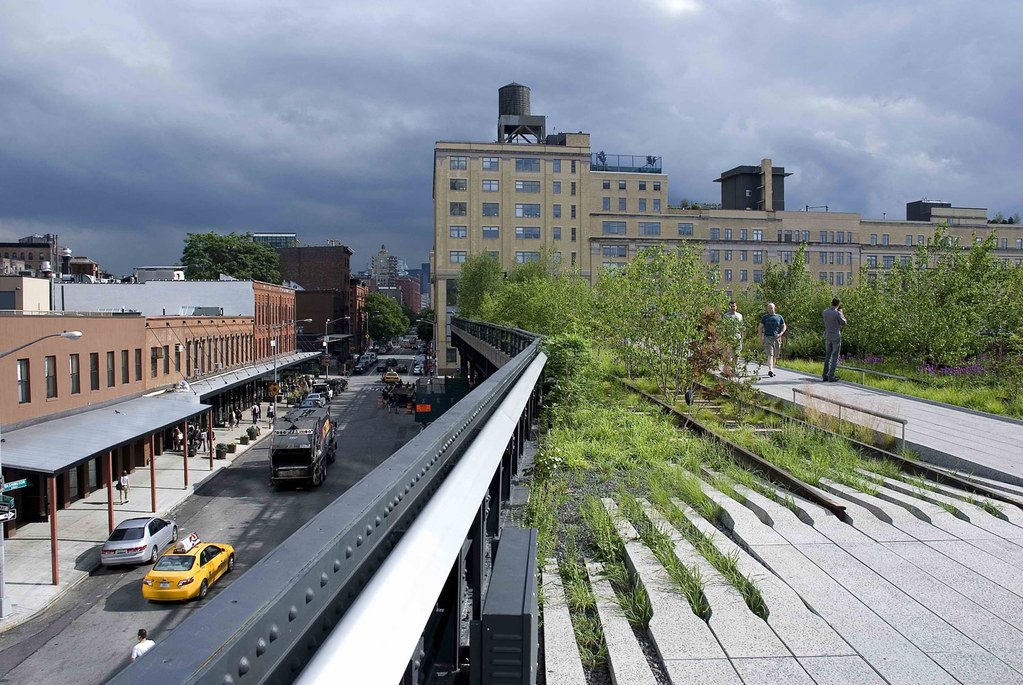
As its name implies, the Ballroom is close to the New York Highline, a park that runs along a long-abandoned elevated old railway stretch, a testimony to the city's cutting edge in design. It's a great place to walk around and view the downtown skyline and the water to the west.
The Highline Ballroom is a medium sized venue/club that usually caters to hipper stuff. Popular pop artists with high appeal give shows of standing room only. You can buy drinks from the bar. Artists of less popular appeal (jazz, classical) may have seated shows. This one of course was a seated show, with full dinner menu available and a $10 minimum (in addition to the admission ticket). I am not sure you can see from the dim picture that the gents and ladies sitting, many British naturally, were having drinks and food. My friend had a hamburger and I a glass of wine. hey, that's nice for a change.
 The program, a mixture of the familiar with the obscure, is the first from Hope's new recording label, DG (which seems to be snapping up all young firebrand violinists in sight; Nicola Benendetti is another example), titled Air, a baroque journey (also click here). Hope introduced every piece, quite charmingly. His playing was HIP-informed and fluent. Ensemble was tight and the baroque instruments were a real sight. Oh, yes, it was amplified, but modestly, so Hope's tone was quite natural. There was no program and Hope introduced his friends by mouth, so I cannot be sure whether they are the same ones (mostly from the COE) on the DG album.
I am almost tempted to get the album, but I'm sure the library shall have it in due time. Meanwhile I noticed the album is available as FLAC file. Now, I'd love to hear that.
06 April, 2010
Concert Review: Borodin String Quartet
 Concert Review: Borodin String Quartet
March 24, 2010, Alice Tully Hall
Borodin String Quartet
Brahms-Rachmaninov-Tchaikovsky
I was very happy for the priviledge to hear one of my favorite quartets (two others would be the Artemis and the Shanghai), the Borodin Quartet, for the fourth time, and in Alice Tully Hall, which I have not visited after its re-opening.
The group has remained the same since death of the great Berlinsky. They still play with peerless unainimity and a golden blend ( see my review in 2008). The great surprise is that in the new Alice Tully Hall two aspects of their sound have changed: first, first violin Aharonian's tone is less white than before, still penetrating but without glare; second, the tone of cellist Balshin, previously smallish, has firmed up considerably. The balance is more generous. This could be due to change of the quartet's sound (not unusual) but could also at least partly be attributable to the much praised acoustics of the completely rebuilt new hall, which is a little larger than life, and warmish.
The program was surprisingly challenging. Neither the Brahms Second nor the Tchaikovsky Second are often encountered. Both were played perfectly, the thorny knots of the Brahms untying themselves with ease, and the Tchaikovsky scaled new heights of sophistication. In between came the early Rachmaninov's Romance from Two Movements for String Quartet.
30 March, 2010
Concert review: SZO-Ehwald-Mahler 1st
 Concert review: SZO/Ehwald/Mahler 1st
March 12, 2010, SZ Concert Hall
Shenzhen SO/Christain Ehwald/Zhang Le 张乐
Brahms/Mahler
The past month has been really busy and I have been too busy to keep up. This is written from NYC.
For the last two months and more, there has been a complete lack of information about upcoming concert events of the SZO from their nearly useless website. Well, I thought to myself, maybe it's just the Chinese New Year. But then well into March and nothing. I was beginning to think crazy things, like, has the SZO suffered a political turmoil? Insufficient funding? Who knows!
I was preparing for my trip back to NYC and decided not to go to the Ashkenazy concert on Friday. But on that morning, I checked and was astonished to find that that evening there was the SZO inaugural concert for the Spring season, and Mahler no less! I re-shuffled my engagements and headed north late afternoon.
The opener was the Brahms Violin Concerto with concertmaster 张乐 as soloist (Wang Sze Hang acted as guest concertmaster). This was my second experience of this piece with this orchestra, the first being in 2008 (read review here)! In this very different venue, 张乐 actually sounded better and sweeter in tone than the previous soloist Chen Xi 陈曦, and he certainly did not break a string. He was notably smoother and his playing had a better breath. The accompaniment was excellent. However, overall a little tension is lacking.
I was relieved when I saw the large orchestra for the Mahler 1st. Perhaps there has been no funding cut? The performance was pretty much as expected for this conductor (review of Mahler 6th here). Firm grip of architecture, excellent balance and grading of dynamics.The opening pianissimo was ravishing but not quite mysterious or brooding enough. The climaxes were a little congested, and the tympani sounded distorted in my seat (a little further back in the orchestra than usual) during the pandemonium opening of the fourth movement. The brass did a very good job and the winds were solid. Huang Zheng has left for the Macau Orchestra, but the acting first desk oboe lady has always been very good and there was nothing to worry.
Again, what a horrible administration! Updating the website only shortly before the season begins? Asinine! However, I glanced at the schedule and there are quite a few things later in the season that is attractive. Stay tuned.
p.s. The 面点王 restaurant inside 书城 is a good place for a pre-concert meal. You can have a light one, or a heavy one, as you wish.
27 February, 2010
Concert Review: HKPO-EdW-Bruckner 8
Concert Review: HKPO-EdW-Bruckner 8
May 27, 2010, CCCH HKPO/Edo de Waart
Bruckner 8 (1890 Nowak)
For starving Bruckner fans it had seemed good times had finally arrived. After a long drought, HKPO's 8th came hard on the heels of Macau Orchestra's 4th (reviewed in my last post below). Despite much hyperbole from the press, the inevitable comparison is not always to HKPO's advantage.
Recently, EdW seems to have mellowed a little, and the somewhat franctic delivery that used to mar much of his performances for this listener have been tempered a little. As expected, EdW conducted a straightforward interpretation, but the almost relaxed nature came as a surprise. This was a mixed blessing.
On the plus side, music from forte to fortissimo were properly scaled, hence for once true climaxes rang out the loudest, and that's most important in Bruckner, if not for all music. In the loud passages, when the music gained momentum, the orchestral playing was sonorous and satisfying. The orchestra, much larger than Macau's (by about 20 heads), was able to deliver a little more sheer volume, admirably without strain. The brass was very good.
On the minus side, music at the other end of the dynamic scale frequently lacked tension. Some of this was due to the literal conducting, which frequently had a sight-reading feeling. The frequent transitions between soft and loud did not feel inevitable. Some of this was due to the playing. In Bruckner's softer passages, the winds play an important role of pleading, cajoling and calling for renewal. This the pallid winds failed to convey on this occasion. And the strings were rhythmically earth-bound, lacking a springing quality to their steps which the Macau strings possessed in abundance.
For me, next to the curiously ineffective trio, the adagio suffered the most. This pivotal movement started beautifully but regrettably started to drag half-way when the music became tumultuous. For once, I paradoxically thought more urging on by this conductor here and there would have been beneficial. As a whole, the symphony did not have the breathing quality of the Macau performance. Even the well executed and powerful climaxes were too careful by half, and I looked for grandeur in vain.
Lest people think HKPO cannot play Bruckner before EdW, I'd like to point out that HKPO had previously played at least the 3rd, 4th, 6th and 7th. Two performances of the 4th in particular stood out in my memory. An early 90's performance by Yuri Simonov was hair-raising, technically ragged but inexplicably exciting. Then came a gut-wrenching performance by Gunther Herbig, with playing at least as good as on this occasion. Both of those performances had a grandeur that put you in touch with what Bruckner tried to convey in his masterpieces.
Being part of the Arts festival brought a full house, but also a much noisier audience than usual. There was prolonged coughing during the intervals, and once EdW turned his head and looked in dismay. Children tried to run out during the intervals but were stopped by the ushers. Most disruptive was that people were let in during the first interval!!!
For hyperbole I refer you to the promotion leaflet. Re: "Any performance of a symphony by Anton Bruckner is a major occasion, and EdW's inspired interpretation of the monumental Eighth is no exception." Re: "This is also a masterpiece which demands an austere conductor with the power to rein in Bruckner's tendency to diffuseness and shape the parts into the architecture of a titanic, visionary whole. De Waart, master of Bruckner, together with the renowned HKPO will bring his signature interpretation of this orchestral tour de force to the 38th HKAF." Inspired interpretation before the performance? Master of Bruckner? Perhaps from accolades elsewhere? I searched Google and failed to find anything that links EdW with Bruckner's 8th anywhere, indeed very few links to Bruckner at all. The promo team should be blamed for writing something like this.
The concert was reviewed by Sam Olluver in March 4th's SCMP.
I came across some interesting bits:
EdW Milwaukee interview
MSO's 2010/2011 season (Looks like HKPO programs; the only Bruckner is NOT conducted by EdW)
20 February, 2010
Concert Review: Macao Orchestra - Fou T'song - Lu Jia
 Concert Review: Macao Orchestra/Fou T'song/Lu Jia
February 6, Macao Cultural center, Grand Auditorium
傅聰的榮歸 Macao Orchestra/Fou T'song/Lu Jia Mozart/Bruckner
Sometime ago when I found out about this program I was quite excited. A perfect excuse to go to Macau! Although curiously titled as 傅聰的榮歸 (Fou had appeared in Macau many times before) the main part of the program, and what attracted me, was the massive Bruckner 4th. Even though I have been a fan of Lu Jia ever since I first heard him I had question in my mind how the smaller Macao Orchestra would fare in this big work. Surely they had rarely played Bruckner.
Fou T'song
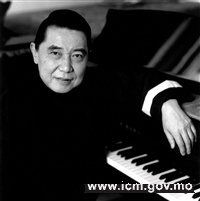
The first part of the concert, Mozart's Piano Concerto No. 23, was surely Fou T'song's glory. Personally, on record I have never been fond of Fou T'song. I had always thought his late recordings of Mozart and Chopin (as evidenced by the many CDs available in the library on small labels) severely mannered. It came as a wonderful surprise that in the concert hall his playing came across as more spontaneous than mannered. His frequent rubati mostly served the musical purpose of pointing. At 76, his dynamics were necessarily compromised but his fingers were remarkably nimble in the middle third of the piano, where most of the music is. Here, he produced beautifully varied tone even with spare pedaling. At either end of the keyboard his frailty showed. Notes were dropped, treble could be brittle and forced whereas bass was rather lacking. None of this detracted from his masterly treatment of the concerto, which came across not as something perfumed nor precious, but serene contemplation punctuated by bouts of drama. The reduced orchestra accompanied beautifully, as one expected of Lu Jia. Two Chopin encores were most delectable, indeed time-stoppingly beautiful.
It would be time for me to re-visit his discography, and I hope to catch one of his recitals soon. While researching his discography I came across some great youtubes clips:
Fou T'song teaching Chen Sa
PRECIOUS footage of Chopin Competition 1955 (where Fou came third, after Adam Harasewicz and Vladimir Ashkenazy)
 Bruckner Symphony No. 4 (click on pic to enlarge)
And now for the main reason of my attendance. I was not sure at all what to expect. Although a fan of Lu Jia I had only heard him as a symphonic conductor in Dvorak. Although that was a perfect performance I did wonder how he, and the orchestra, would fare in the massive Bruckner 4th. I need not have worried.
By Bruckner's standard, the 4th is modest in its requirement of orchestral force. Even then, it's stretching the Macau Orchestra (I am sure its budget too) to its limits. I was told by a former HK Sinfonietta violinist this orchestra has fewer full time musician than most. Indeed for this performance, 23/71 musicians were guest musicians. The performance was a great success due to four main factors.
Firstly, the strings (14, 12, 10, 8, 6), though smaller than usual and comprising 16/50 guest musicians (some HKPO members), played magnificently. They played with uncommon accuracy; I have never heard the duplets and triplets of the so-called Bruckner rhythm executed with such clarity. And they were able to maintain beautiful tone and penetrate even in the most massive moments. Secondly, although the horn section was not as strong as HKPO's, the rest of the brass was superb and played with great radiance and attention to dynamics. Thirdly, there were some characterful wind playing. I am happy to note that Huang Zheng (after a stint with the SZO, which is incidentally mysteriously inactive at this moment) is now principal oboist. Also present was flutist Micheal Hallit, who previously played with the HKPO and whose playing I have greatly enjoyed. Together with acting principal Jin Ta the Flute pair was formidable.
Lastly, and most importantly, Lu Jia held a tight rein over the proceedings. Although a little more mystery would have been welcome, the symphony unfolded beautifully, with coherence and inevitability. Most impressive was the breath of the last movement, which can easily sound disjointed in lesser hands. Beside the architectural grasp, Lu Jia also brought out much beauty of details. Have you ever noticed Lu Jia always coaxed beautiful string tones out of the orchestra? Ovation at the end was tumultuous. Yes, I yelled "Bravo!"
The hall also helped. From my mid-stall seat the sound was luminous and detailed. One interesting observation: the orchestra sat quite into the stage (click on pic above to see). I'm sure this was deliberate for reasons of balance.
p.s. (thanks to RC ) The concert was briefly reviewed (starting around 42:40, emphasizing Fou and little on Bruckner) by Oliver Chou in this episode of RTHK4-Cultural Vibes 創意空間. Enjoy!
19 February, 2010
CDs From The Hong Kong Public Library: Listening Log (3)


 CDs From The Hong Kong Public Library: Listening Log (3)
(From Yuen Long)
I was pleasantly surprised to find new additions, the entire Chandos 30th Anniversary box no less. Lydia Mordkovitch played the Shostakovich Violin Concertos magnificently, and needs to yield to none. I have always loved the Scottish National Orchestra under Neeme Jarvi. Another gem is the coupling of a sparkling Shostakovich piano concerto No. 1 (soloist Dimitri Shostakovich, grandson, accompanied by Maxim Shostakovich, son) and the beautiful Chamber Symphony Op110a (conductor Yuli Turovsky). The I Musici de Montreal is fabulous as usual. In comparison, the objective Tchaikovsky 5th by Oslo PO under Mariss Jansons is very good but not quite top drawer.
Alexei Sultanov Live in Japan is a wonderfully fresh sounding recital. Too bad this pianist died young.
Not for everyone is the Schoenberg Piano Concerto played wonderfully by Mitsuko Uchida and the Cleveland Orchestra under Boulez (Philips). The solo pieces are spontaneous sounding as well.
Volume 1 of the Nielsen String Quartets (Dacapo) shows surprisingly sophisticated playing by The Young Danish Quartet. The SACD/CD is magnificent in sound. Wonderful! Now, I wonder if Volume 2 is around...
(From Tsuen Wan)
In contrast, The Grieg String Quartets played by the Raphael Quartet (Regis) pale in comparison. More enticing was the elegant Carmina Quartet's rendition of the Debussy/Ravel (Brilliant Classics). The original Denon recording is magnificent. This is a 2-CD set, coupled to the same composers' even more enigmatic Piano Trios, in somewhat rigid performances by Trio Rouvier/Kantorow/Muller (originally Erato).
Speaking about Grieg, the classic coupling of Grieg/Schumann Piano Concertos were given dynamic readings by the always wonderful Leif Ove Andsnes with the BPO under Mariss Jansons (EMI). Sound is wonderful.
Grigory Solkolov's Chopin's Sonata No. 2 and the Op 25 Etudes (Opus 111) took a little getting used to but I was a great believer by the end of my second listening. Read the Gramophone review.
10 February, 2010
主编的话: 虎年
 主编的话: 虎年
踏入 2010 年后,虎年在即,忙七忙八,没太多时间做真正想的事。 我们中国人已要过两个年,香港人更把年底的圣诞节也纳入,忙上添乱。有些要说的在元旦日的文章里说了,不再重复。现在要出几天远门,就在此跟各位拜个年。 祝各位身体健康。
30 January, 2010
Concert Review: HKPO-Trcepski-Lu Jia
 Concert Review: HKPO/Trcepski/Lu Jia
Jan 29, 2010, CCCH
HKPO/Simon Trpceski/Lu Jia
All Rachmaninov
Macedonian pianist Simon Trpceski is a star on the international circuit, and it's good that he continues his traversal of Rachmaninov here. The partnership with Lu Jia proved a match made in heaven.
The Piano Concerto No.1 was actually substantially revised after Rachmaninov's hugely successful N0. 2 and 3 (more on its history here). It's an unjustly neglected work on the concert platform. Ever since I heard the Richter recording on a cheap Monitor LP over 20 years ago I have loved it, and over the years it has eclipsed the No. 2 (but not quite the No. 3) in my esteem due to its concision. Even fresh off 2 library CDs of this concerto (Zimerman and Berezovsky; see previous post) I still found this live performance refreshing. This not so "romantic" piece quite matched Trpceski, who has all all the chops needed for anything but who prefers to hone his skills on producing chiselled tones and a sense of spontaneity. The same can be said of the Variations on a Theme by Paganini, which Trpceski played sometimes with a little injection of almost jazzy feeling. This performance far outstripped the lackluster one by Dejan Lazic and Atherton 2 years ago.
Important to the success of the 2 concerti were the contributions by orchestra and conductor. Lu Jia again proved himself a great accompanist. There was a good sense of give-and-take, enjoyment and dialogue. Except for somewhat subdued winds, orchestral playing was smart and snappy.
The wonderful program opened with the dark Prince Rotislav, a piece I have loved ever since I first heard it on a library CD. The hushed opening and soft brass playing was quite magical; so were the successive storms. Closing the program was the lesser but rousing Caprice Bohemian. In both tone poems Lu Jia showed considerable skills in moulding and color-painting.
The concert was broadcasted live by RTHK4, and the program shall be repeated on Feb 3rd (wed), at 2 pm.
26 January, 2010
CDs From The Hong Kong Public Library: Listening Log (2)
 CDs From The Hong Kong Public Library: Listening Log (2)
(From Taipo)
Krystian Zimerman's Rachmaninov Piano Concerto 1+2 (DG) has garnered praise, but I find both the recording and performance poorly balanced (like his even more recent Brahms). Partnership and performance by the younger Zimerman with Boston SO/Ozawa is a lot better in Liszt's Piano Concerto 1+2 (DG). Boris Berezovsky's performances of Rachmaninov's 1+4+Paganini (Mirare) strike me as much more satisfying in performance and sound (2 of these playing this week by the HKPO). I have never heard of the Ural SO nor the conductor Dimitri Liss, but their contribution is idiomatic and first class.
Buried in the bargain 2-CD set(Capriccio) under the mundance title "Russian Violin Concertos" (filed under "RUS") are TOP performances by the seriously under-rated Bulgarian Stoika Milanova, a pupil of Oistrakh. The Prokofiev and Shostakovich concertos are all top-class. Only the Tchaikovsky is performed by Viviane Hagner. While slavic soloists rarely fail me, the rather flat Schubert CD by Russian cellist Leonid Gorokhov (AGPL) certainly was uninspiring. Partner Demidenko is rather coarse.
The library is a good starting place also to explore less known music. Julius Rontgen's 3 cello concertos (Et'cetera) are wonderfully entertaining and deserve a place in the repertorie. Many libraries have a huge series of (mostly Supraphon) Martinu, all in wonderful performances and sound. His harpsicord works (some concertante) (filed under "KNO") are curiosities but interesting.
I have never heard of Tanja Becker-Bender, but everything the reviews said of her Paganini 24 Caprices (Hyperion) is true. A wonderful CD with a fantastic cover painting (more info here). I have always liked Elizabeth Wallfisch, but in her comprehensive Locatelli "Art of the Violin" CD set (Hyperion), neither she nor the orchestra measure up to the sparkling playing of smaller offerings from the likes of Giuliano Carmignola (Sony).
(From City Hall)
On (Chandos), Valerie Polyansky has come in for a lot of bad reviews on the net, but I often find some salvation in the beautifully contoured playing of the Russian State Symphony orchestra. His Rachmaninov Symphony 2 is a bit turgid, not for those who like things to move along. Sound is somewhat murky.
(From Tsuen Wan)
Osmo Vanska's (BIS) Beethoven Symphonies 4+5 and Symphony 9 both offer wonderful playing that's full of tensile strength and rhythmic felicities. The SACD/CDs are beautiful sounding. Too bad the library does not have the rest of the cycle. BIS is offering the cycle at mid-price. I've ordered a set.
23 January, 2010
CDs From The Hong Kong Public Library: Listening Log (1)
CDs From The Hong Kong Public Library: Listening Log (1)
Note: With this post I'm creating a new series. In the past I've written more detailed "Listening Logs", but it's all too time-consuming to compose and load pics. With this new series, I shall be introducing CDs available in the HKPL libraries. I shall indicate where I have borrowed the CD, though it may be available in other branches. To save time I shall post links to pics rather than load pics of everything.
Exciting String players, mostly young
It's not easy to make a good album out of small pieces. Waxman's Carmen Fantasie opens Lara St John's Gypsy (WellTempered) (from City Hall), and it captured me immediately due to the marvelous pianism of "accompanist" Ilan Rechtman. The fiddling ain't bad either! The recording is absolutely stunning; the pizzicati just leap at you! This hugely enjoyable CD brings back memory of the wonderful Tianwa Yang's Sarasate (Naxos Volume 1; Volume 2) (available in many branches, including City Hall), all musts for violin fans. These I enjoy more than Chloe Hanslip's Bazzini (Naxos) as I find this composer a little monochromatic. It's amazing how many people only listen to the "soloist" and ignore the contribution of the accompanying musician(s). Think Heifetz: his orchestra's and conductors provide him with superb frameworks missing from much of their modern counterparts.
The library is suffused with Szymanowski CDs. Ever since I heard the magnificent (but much under-rated and neglected) Wanda Wilkomirska play the Violin Concertos (still benchmarks) I have become a fan of this composer. Ilya Kaler (Naxos) (City Hall) plays both concerti, whereas the very young and talented Nicola Benedetti (DG) (Tuen Mun) plays only the No. 1. Both CDs have excellent performances. The piano music is not to be missed either. Piotr Andreszewski's Masques and Piano Sonata 3 (Virgin) (City Hall) are spellbinding and given a superb recording.
Christian Poltera's Otmar Schoeck CD (BIS) (City Hall) shows a very fine player, and the music is rewarding. I think the library has his other BIS CDs, which I shall surely check out.
If you like baroque guitar music other than Bach (like Weiss and Pachebel etc) you might like Goran Sollscher's Eleven-String Baroque (DG) (City Hall). The sonority of the beefy instrument is interesting, but in the same repertoire I prefer the playing of lutist Hopkinson Smith (Harmonia Mundi). As for the guitar, how come few can play with the soul of Segovia?
I am not a fan of Lorin Maazel, but his VPO Mahler's 5th (Sony) (City Hall) is superb. The playing of the VPO is nonpareil; you simply hear more details. Despite occasional highlighting, sound is excellent. As you might expect, this is not a heart-on-sleeve interpretation but it's a penetrating one. Three of us listened to almost the whole thing Saturday afternoon!
01 January, 2010
 主编的话:2010 看 “后 97“ 年代
在新一年的第一个早上,我继续看《七十年代》,一本令人反复反思的好书。阿城说得好:
“... 可以说,八十年代结束于1989年。八十年代早结束了一年。 1976年结束了七十年代,七十年代早结束了四年。 不过,算上1976年后的四年,八十年代有十三年。 七十年代呢,从1966年算起,有十年,所谓十年“无产阶级文化大革命”。按 decade 划分,不准确,不符合。人生不是猪肉,不可以这样一刀一刀按斤切..."
那我们香港的零零年代呢?我认为应该称为 “后 97“ 年代, 还没结束,漫长的等待但愿不会以悲剧画上句号。我是不乐观的。
回到音乐,与很多其他的东西一样,这 "十年" decade 最大的改变来自网络。也跟其他的东西一样, 这有好有坏。好的是资讯多了,人多了,联络频繁了; 坏的是不好的资讯也多了,转载泛滥, 平庸的音乐家居然会被捧为〈大师〉,分裂多了也就分薄了力量,一般素质越来越差, 更流于肤浅。 在某些网页上,有贡献的文字比恶毒攻击更稀少,场面靠一些 CD/LP 封面支撑。可叹!
在这浮华的年代,有心人只好默默地用自己的经验和方法在海里捞针, 能做好自己的就很好了!这个 Blog 开办才一年多, 没太多的时间打理,希望新的一年能更实际地为大家带来更充实的内容。 我欢迎读者给我意见 (doctorjohn@myself.com)。
我在香港的时候, 每星期都会过深圳。那里没有电脑, 没法写东西以至很多题材只能装在脑里。如果一切没变的话,我希望今年能在那里搞一台方便自己。现在是太多东西想写,时间却太少。
自 从〈掌心雷〉手写板报废了后,都在用简体拼音法输入中文, 一方面因为母语是国语能适应,另一方面也能令自己的发音更进步,一举两得。以往会用翻译器翻成繁体,可是有些字,像〈最后〉的〈后〉或 〈这里〉的〈里〉, 是翻不过来的, 只能成为繁体里的白字 (一些中英文都糟糕透的猢狲还曾为此大造文章, 煞是可笑)。其实我也嫌烦,就索性用简体吧, 反正一家,而文章重要的还是内容, 创新和表达。当然,有时间的话, 我是会想学个繁体的键盘输入法, 毕竟繁体字好看,也是传统。
在此祝各位 Happy New Year! 展望每个香港人能最后自己说了算!
附:《七十年代》按这里 和 按这里 可看部分。张郎郎〈宁静的地平线〉一篇 非看不可;里面有个死囚的爱情故事,令人看了唏嘘不止, 痛入心肺。这书最好能买下,以便慢慢细嚼。书里面有许多小故事,对于国家,个人,以及自由民主的反思与响往, 还有受害者表达出来的宽恕与宏观 , 更令人动容。反之,充斥香港网上, 用来攻击人的〈爱国〉,〈爱港〉,〈黄白〉论调, 每每显得表面, 而因缺乏对自身及历史的认知更为可怕。
19 December, 2009
Opera Review: Janacek and Salonen
 Opera Review: Janacek and Salonen
November, 2009
Janacek From the House of The Dead
Metropolitan Opera, Esa-Pekka Salonen
I watched this opera just before I came back to HK. It was everything the NY Times review said it is, and more. I liked the Chereau staging, austere in the extreme, comprising a few grey cubes that change subtly in combination as the action "proceeds", much like LEGO products. The conducting of Salonen was positively one of the best I've heard in the opera house. Indeed, this opera is meant as much to be heard as seen. This is not an easy opera to listen at home, but after watching this production, perhaps I shall re-visit it one day just for the great music, way ahead of its time.
Coverage of 2007 European premiere conducted by Boulez
20 November, 2009
Concert Review: Philadelphia Orchestra Eschenbach
 Concert Review: Philadelphia Orchestra - Christoph Eschenbach
November 19, 2009, Carnegie Hall
Mahler Symphony No. 7
For some reason I always run into concerts by the Philadelphia Orchestra and concerts by Christoph Eschenbach (sometimes together) whenever I'm in NYC. This time, I was not able to get tickets for the BPO/Rattle Brahms cycle, but this concert, coming hard on the heels of the BPO, was oddly satisfying. I may not always like Eschenbach's often wayward and aloof ways, but I have high regards for his considerable strengths, chief amongst which the ability to re-think warhorses and cultivated imagination.
The Philadelphia is a staggeringly good orchestra these days (has always been in fact). It really is a pleasure hearing them play anything. That aside, perhaps their Mahler credential is not as strong as some of their brethens, like the CSO, NYPO, even BSO. In the vast canon of recorded Mahler, the Philadelphia had only a small share and even fewer that are distinguished, but that is changing due to the Ondine recordings (cycle?) conducted by Eschenbach.
Their burnished tone is not just confined to their famous strings, rather to all sections. Despite their powerful playing, nothing grates the ears, and that can be a little disconcerting in Mahler, where you likely want to hear struggles. Add to the equation the cool Eschenbach, and the enigma of the 7th symphony, this was not a concert for those who want pathos, or at least a healthy dose of sturm und drang. Although it took a while for the players to warm up to their best, under Eschenbach's gripping direction the symphony unfolded fluently. Sometimes the tempo was too fast for the music not to sound dispassionate. An example was gearing up for the last part of the sprawling first movement, at a tempo that was surely allegro, but not ma non troppo. Similarly, the Rondo-Finale was taken at a clip, with occasionally odd rhythmic pointing, so the conclusion was resounding enough but stripped of some triumphal grandeur. The story-telling here portrayed mother nature as finicky, even idiosyncratic, but not at all malignant. Perhaps that is fitting enough for a symphony Mahler calls his happiest.
Eschenbach brought out a wealth of details along the way. This worked best in the three inner movements, where I savored every second of the enchanting playing. They not only played with great individuality but they listened to each other and sometimes it felt like chamber music on the grand scale, not a bad way to play Mahler's reflection on nature and man.
When it ended, the fellow behind me said: "...(Eschenbach) is all nuts in his head, but how he made them PLAY!..." The appluase was tumultous. The hall was packed and the balcony was stuffed by young students. How refreshing. Mahler's future is bright. A wonderful concert.
The Philadelphia Inquirer's review of the concert one day before
The NY Times review
19 November, 2009
Opera Review: La Damnation de Faust
 pic of production from the NYT
Opera Review: La Damnation de Faust
Metropolitan Opera
Berlioz La Damnation de Faust
NYT review (full review of original 2008 production)
NYT review (capsular review of this 2009 revival)
Although the visual alignment was not perfect for someone sitting in the family circle, one could see all the happenings and even learn how some of the visual tricks were achieved. Aligned close to the front, the simple set of evenly spaced tall support columns and planks spanning the full width of the stage divides the vertical plane into grids. Aided by video projection onto mechanized screens these were alternately transformed into rooms with windows. The rooms were populated most of the time by the chorus and dancers, less often by the main characters.
The visuals were riveting most of the time. One got busy in the futile attempt to register everything happening in every grid. The lighting was masterly, imparting much needed three-dimensionality to the relatively compressed depth of the production. Only in certain scenes, such as the ride to hell, did the compression become painfully evident. The direction gave much for the chorus and dancers to do, and that is apt as they as much as the soloists are the stars of this opera/oratorio/music drama. The chorus sang solidly and the dancers were bent on their acrobatics.
The largely successful deployment of the chorus and dancers unfortunately threw the singers into not always flattering relief. Ramon Vargas sang Faust relatively stylishly but could not fill the hall. Despite her poorer diction, Olga Borodina sang better but was visually unconvincing as Marguerite. One cringed when in the Epilogue her large body had to climb up the stairs to heaven. Better was the Mephistopheles of Ildar Abdrazakov, the real-life partner of Borodina. Perhaps fatigue had set in by the end of the run. Note that the cast was completely different from that of last year (see NYT link). James Conlon conducted efficiently and the orchestra played well, though I think the score’s lyricism was not always in abundant supply.
Subscribe to:
Posts (Atom)